
ZAPLETENOST BESEDILNEGA POMENA / COMPLEXITIES OF
22. evropska konferenca in delavnice sistemsko-funkcijskega jezikoslovja The 22nd European Systemic Functional Linguistics Conferece and Workshop ZAPLETENOST BESEDILNEGA POMENA / COMPLEXITIES OF MEANING IN TEXT 9.11. julija 2010 / 9th–11th July 2010 Koper, Slovenija Izvlečki / Abstract Booklet 22. evropska konferenca in delavnice sistemsko-funkcijskega jezikoslovja / 9.–11. julija 2010 22. evropska konferenca in delavnice sistemsko-funkcijskega jezikoslovja The 22nd European Systemic Functional Linguistics Conference and Workshop ZAPLETENOST BESEDILNEGA POMENA / COMPLEXITIES OF MEANING IN TEXT UP PEF, FHŠ Koper, 9.-11. julija 2010 / 9th-11th July 2010 IZVLEČKI – ABSTRACT BOOKLET Urednile: Sonja Starc, Šarolta Godnič Vičič, Mojca Šauperl, Aleksandra Bizjak Končar Naslovnica: Eda Patru Prelom in tisk: Boex DTP, d.o.o. Naklada: 150 izvodov Založnik: Univerza na Primorskem, Pedagoška fakulteta Koper Za založnika: Mara Cotič Sedež: SI-6000 Koper, Cankarjeva ulica 5 tel: + 386 5 66 31 260, fax: + 386 5 66 31 268 http://www.pef.upr.si/ e-mail: info@pef.upr.si Delno sofinancira ARRS / Financial contribution CIP - Kataložni zapis o publikaciji Narodna in univerzitetna knjižnica, Ljubljana 81’42(082) EVROPSKA konferenca in delavnice sistemsko-funkcijskega jezikoslovja (22 ; 2010 ; Koper) Zapletenost besedilnega pomena : izvlečki = Complexities of meaning in text : abstract booklet / 22. evropska konferenca in delavnice sistemsko-funkcijskega jezikoslovja, 9.-11. julija 2010 = The 22nd European Systemic Functional Linguistics Conference and Workshop, 9th-11th July 2010, Koper, Slovenija ; [uredile Sonja Starc ... et al.]. - Koper : Pedagoška fakulteta, 2010 ISBN 978-961-6528-90-0 1. Gl. stv. nasl. 2. Vzp. stv. nasl. 3. Starc, Sonja, 1954251569408 2 The 22nd European Systemic Functional Linguistics Conferece and Workshop / 9th–11th july 2010 Kazalo / Index Program / Programme James Martin Christopher Taylor Eija Ventola 5 Scaffolding semogenesis: Designing teacher/student interactions for face-to-face and on-line learning Language as access: transposition and translation of audiovisual texts as a vehicle of meaning and a gateway to understanding Linguistic and visual realisations of tourism and commercialization: Handel and Mozart 9 10 10 Sekcije / Parallel Sessions 11 Delavnici / Workshops 72 Drobne informacije o Sloveniji / A little bit about Slovenia 74 3 The 22nd European Systemic Functional Linguistics Conferece and Workshop / 9th–11th july 2010 Zapletenost besedilnega pomena / Complexities of meaning in text 22. evropska konferenca in delavnice sistemsko-funkcijskega jezikoslovja The 22nd European Systemic Functional Linguistics Conference and Workshop PROGRAM/PROGRAMME Četrtek / Thursday, 8 July 2010, 20.00 Petek/Friday, 9 July 2010 8.30–10.00 Dobrodošlica udeležencem / Welcome Atrij pred FHŠ / Atrium, Faculty of Humanities (FH) 10.00–10.30 Slovesna otvoritev / Opening of the conference Tramontana lecture room 10.30–11.30 Plenarno predavanje /Plenary - Cristopher Taylor: Language as access: Transposition and translation of audiovisual texts as a vehicle of meaning and a gateway to understanding 11.30–12.00 Kava / Coffee – Atrij FHŠ / Atrium FH Sekcije / Parallel sessions 12.05-12.35 Maestral 1 Preds./Chair: Susanna Shore Maestral 3 Preds./Chair: Lucie Betáková Levant 1 Preds./Chair: Tom Bartlett Robin Fawcett: A survey of available SFL descriptive frameworks for analyzing ‘complexities of meaning’ in text Elissa Asp: Semantic representations in the discourse of people with probable Alzheimer’s disease Mohamed el-Sharkawi: The semantic functions of word order in modern written Arabic 12.40-13.10 Geoff Thompson: “But it was.” Conjunctive relations and free indirect discourse 13.10-15.00 Kosilo /Lunch Sekcije / Parallel sessions 15.00-15.30 Maestral 1 Preds./Chair: Merja Torvinen Maestral 3 Preds./Chair: Arianna Maiorani Levant 1 Preds./Chair: Claudia E. Stoian Agnes Pisanski Peterlin: Interpersonal function in translation of academic writing: A corpus study of research article abstracts Tom Bartlett: Caution! Personas at play. Ethnography, multicodality and meaning at risk Tatjana Balažic Bulc & Vojko Gorjanc: A corpus-based approach in functional linguistics: Connectors in Slovenian and Croatian linguistic discourse 15.35-16.05 Ann Montemayor-Borsinger: Complexities of interpersonal meanings: An analysis of dialogues from Spanish literature translated to English Anke Schulz: It’s not easy Donna Miller: The ‘Doublearticulation’ of verbal art: defying to be a negation marker: A contrastive study of negativity Ockham’s Razor? in English and German newsgroup texts 16.10-16.40 David Banks: Thematic structure Wendy Bowcher: Material and progression in some late action and contextual field seventeenth century French texts Registracija udeležencev / Registration Atrij FHŠ / Atrium FH Tramontana lecture room Levant 3 Preds./Chair: A. Pisanski Peterlin Marina Manfredi: SFL as a tool for translation practice: Translating multi-layered meanings across texts/ contexts/cultures Ekaterina Shagalov & Giulia Beltrami: Complexity in a Merja Torvinen: Making Jonathan Fine: Speech fluency unit: A phraseological approach meaning in translation measures in schizophrenia to support verb constructions – A translation-oriented text and mania in relation to the analysis processing of cohesive markers Levant 3 Julia Lavid, Jorge Arús, Lara Moratón: Investigating thematic meaning in English and Spanish: A methodological proposal 5 22. evropska konferenca in delavnice sistemsko-funkcijskega jezikoslovja / 9.–11. julija 2010 16.40-17.00 Sekcije / Parallel sessions 17.00-17.30 17.35-18.05 20.00 Sobota / Saturday, 10 July 2010 Sekcije / Parallel sessions 8.45-9.15 9.20-9.50 9.55-10.25 10.25-10.55 11.00-12.00 Sekcije / Parallel sessions 12.05-12.35 12.40-13.10 6 Kava / Coffee - Atrij FHŠ / Atrium FH Maestral 1 Preds./Chair: Maestral 3 Preds./Chair: Krzysztof Ozga Wendy Bowcher Levant 1 Preds./Chair: Elissa Asp Alireza Jalilifar: Appraisal and thematic patterning in the centrality claim section of research articles Levant 3 Preds./Chair: Carlos Gouveia Katja Plemenitaš: Gerard O’Grady: When new is not new Nominalization as a but significant: An investigation of tonicity discursive phenomenon selections in monologue from the perspective of text cognition Chonlada Laohawiriyanon Antonella Luporini: Mikko T. Virtanen: Negative prosodies in Combining frame semantics Finnish academic book reviews & Asma Tasanameelarp: Data-driven learning and and SFL transitivity for text student capacity for selfanalysis: A case study correction: Investigating the use of concordances with low intermediate EFL learners Županov sprejem / Mayor’s reception - Lapidarij Pokrajinskega muzeja / Museum Lapidary Florian Hiss: Dead or alive? Negotiating language maintenance and revival Maestral 1 Preds./Chair: Elizabeth Swain Maestral 3 Preds./Chair: Anne Mäntynen Levant 1 Preds./Chair: Alex M. Kunst Levant 3 Preds./Chair: David Banks Ana Tominc: Recontextualising Jamie Oliver’s cookery books into Slovene: Changes in the interpersonal component of texts Ivan Berazhny: Alcohol Advertising in Aeroflot’s in-flight magazine Maria Alzira Tavares de Sá & Carlos A. M. Gouveia: Appraisal in school narratives: Report on a research project José María González Lanza and A. Jesús Moya Guijarro: The communicative dimension of the TV series Absolutely Fabulous: A multimodal analysis within the interpersonal component Afrooz Pourdad: The structural patterns of grammatical metaphor in Iranian physic textbooks from 1877 to 2007 Mafalda Mendes, Carlos Dorothy Economou: Standing out on Gouveia & Mário Martins: social issues: Evaluative complexity in Tasks as writing frames in large verbal-visual displays in the news school writing Attila Krizsán: “The EU is not them, but us!” The first person plural and the articulation of collective identities in EU political discourse Sook Hee Lee: An application of interpersonal meaning driven pedagogy in a staff development program for EAP teachers Ivana Marenzi: Textual choices and complexities: Trainee teachers’ reflections on the process of text and genre selections in a Web 2.0 environment Carlos Gouveia: Mastering Birgit Huemer: Verbal meanings in Jesús Moya Guijarro & multimodal art installations José María González timeframes: Setting up chronological time in school Lanza: Verbal and visual intersemiosis in Gorilla narratives by Anthony Browne: A functional and multimodal analysis Kava / Coffee - Atrij FHŠ / Atrium FH Plenarno predavanje /Plenary – Eija Ventola: Linguistic and visual realisations of tourism and commercialization: Handel and Mozart Tramontana lecture room Maestral 1 Preds./Chair: Birgit Huemer Maestral 3 Preds./Chair: Donna Miller Levant 1 Preds./Chair: Marta Carretero Anthony Baldry: Diachronic perspectives on multimodal genre analysis: A web as corpus approach Arianna Maiorani: Movies as complex interactive messages: A proposal for a new method of analysis Jennifer Herriman: NToini Rahtu: The use of the first person in rhemes in English problem- Finnish scientific writing solution texts Anu Harju: Evaluation, Melani Nekić: Croatian and Scottish tourism appraisal and manipulative websites as multimodal meaning-making language in Nokia events recruitment advertising Levant 3 The 22nd European Systemic Functional Linguistics Conferece and Workshop / 9th–11th july 2010 13.10-15.00 Sekcije / Parallel sessions 15.00-15.30 15.35-16.05 16.05-16.30 16.30-17.00 17.05-17.35 19.00 Nedelja / Sunday 11 July 2010 Sekcije / Parallel sessions 8.45-9.15 9.20-9.50 9.55-10.25 Kosilo/Lunch Levant 1 Preds./Chair: Krzysztof Ozga Maestral 1 Preds./Chair: Ana Tominc Maestral 3 Preds./Chair: Jorge Arús Bernardina Petrović & Tamara Gazdić –Alerić: The semantic concept of cohesion in public communication in the Croatian language Mira Krajnc Ivič & Andreja Žele: Ellipsis between system and text: Narrower-interest dialogical and widerinterest monological texts Claudia Elena Stoian & Rachel Whittaker: Meaning in images: Complexity and variation across cultures Elke Teich, Stefania Degaetano, Mônica Holtz, Tatsiana Marković: Creating meaning through colligation: Linguistic variation in scientific texts Andreas Nord: Positioning the reader in a polyfunctional text: Attitude and reading path in a modern Swedish handbook on gardening Cinzia Bevitori: Climates of meaning: The rhetorical functionality of should in UK and US editorials on climate change Levant 3 WORKSHOP Robin Fawcett & Anke Schulz: Knotty problems in the analysis of meaning: A practical workshop using SFL descriptive frameworks for analyzing text-sentences Kava / Coffee Atrij FHŠ / Atrium FH Maestral 1 Preds./ Maestral 3 Preds./ Levant 1 Preds./Chair: Mick O’Donnell Chair: Anne Mäntynen Chair: Cinzia Bevitori Lucie Betáková: The Mersini Karagevrekis: Kerstin Kunz, Karin Maksymski, Erich Analysis of classroom Multimodal analysis Steiner: GECo: A comparison of cohesion discourse with special of genres of economic in English and German – empirical emphasis on teacher representation in EAP/ methodology and typological background follow-up move ESP Jernej Vičič: Is the Machine translation Neva Čebron: A Gaja Červ: Evaluative Corpus-based approach and interpretative ready for SFL? to teaching English for practice in Slovene specific purposes newspaper journalistic genres: A corpus-based text linguistic approach Konferenčna večerja / Conference Dinner - Zbor na pomolu, meeting point – pier Maestral 1 Preds./Chair: Maestral 3 Preds./Chair: Ann Montemayor-Borsinger Anke Schulz Levant 1 Preds./Chair: Goeff Thompson Stella Neumann, Adriana Pagano, Fabio Alves, Pirita Pyykkönen, Igor da Silva: Targeting (de-) metaphorization: Processbased insights António M. S. Avelar: Appraisal and genre theories as tools to understand teaching, learning and assessment process of PLE Corinne Maxwell-Reid: Complexities of meaning in secondary school textbooks: An analysis of English and Spanish geography texts Jane Helen Johnson: The attribution of point of view: Complexities in narratorial meaning-making in the works of a nineteenth century Italian novelist and their translations Marta Carretero & Maite Taboada: Products, consumers and evaluation: A proposal of solutions to problematic issues of Attitude in English and Spanish consumer reviews Elizabeth Swain: Reasoning Erik Castello: Complex meaning relations around justification in tourist texts: Implications for a course in English/Italian contrastive lexicogrammar Anne Mäntynen & Susanna Shore: Hybridity Nguyen Thi Thu Ha: A feminist critical discourse analysis of gender ideologies in the Vietnamese printed media Levant 3 Preds./Chair: Attila Krizsán Tazanfal Tehseem: Transitivity in Media Discourse: A lexicogrammatical approach toward the analysis of Pakistani English newspaper editorials Alex Matthew Kunst: From Roosevelt to Obama: Political discourse and its complexities in meaning Paul Bayley: Semantic constructions of ‘citizenship’ in the French, Italian and UK press 7 22. evropska konferenca in delavnice sistemsko-funkcijskega jezikoslovja / 9.–11. julija 2010 10.25-10.45 10.45-11.00 Kava / Coffee Atrij FHŠ / Atrium FH Information about the ISFC 2011 (Lisbon, Portugal) 11.00–12.00 Sekcije / Parallel sessions 12.05-12.35 12.40-13.10 13.10-15.00 Sekcije / Parallel sessions 15.00-15.30 Plenarno predavanje /Plenary – James Martin: Scaffolding semogenesis: designing teacher/student interactions for face-to-face and on-line learning Tramontana lecture room Maestral 1 Preds./Chair: Adriana S. Pagano Maestral 3 Preds./Chair: Antonio M. S. Avelar Levant 1 Preds./Chair: Neva Čebron Levant 3 Preds./Chair: Toini Rahtu Susan Hood: ‘I was there’: Recontextualising story genres into academic writing Carys Jones: An SFL perspective on the pros and cons of a generic pedagogical approach to post-graduate student writing Gail Forey, Graham Lock, Bette Li King: SFL and genre-based pedagogy: The complexity of teaching in the Hong Kong classroom Kosilo / Lunch Maestral 3 Preds./Chair: Antonio M. S. Avelar Yuchen Yang & Zhong Yang: Problemsolution in English vs. Qi--cheng-zhuanhe in Chinese: Are they compatible discourse patterns? Krzysztof Ozga: Communicative grammar - a key to text interpretation: ideation, interaction and text organization Zhang Mosang: On the development of theme Gabrina Pounds: Adapting the SFL-based ‘appraisal’ framework to map the semantic complexities of clinical empathy Monika Kavalir: Distribution of meaning in existential sentences: A functional analysis of Slovene Maestral 1 Preds./Chair: Gabrina Pounds Adriana S. Pagano & Anabelle Lukin: Exploring language in verbal art: A case study of Katherine Mansfield’s Bliss Biook Behnam & Golpar Bahar: A Comparative analysis of the appraisals used for male and female characters in Thomas Hardy’s short stories Shohreh Bolouri: Critical discourse analysis of a political text using appraisal theory 15.35-16.05 Tahereh Ishany: The issue of coherence in a Narrative Ghazal by Hafez: A linguistic enquiry 16.05-16.30 16.30-17.00 Kava / Coffee Atrij FHŠ / Atrium FH 17.30 Ponedeljek / Monday, 12 July 2010 8 – Meeting of the ESFLA at 14.00 Levant 1 Preds./Chair: Jennifer Herriman Levant 3 Inger Lassen: Discursive constructions of citizen involvement in the climate change debate: Meaning negotiation between grammar and discourse WORKSHOP Mick O’Donnell: Exploring complexities of meaning through corpus analysis Peter Muntigl & Ashley Watkins: Some notes on the grammar of “I thought”: A discursive perspective Zaključek conference / Closing remarks Ogled Kopra / Guided tour of Koper (walk) Izlet / Excursion The 22nd European Systemic Functional Linguistics Conferece and Workshop / 9th–11th july 2010 Plenarna predavanja / Plenaries James Martin Sydney University, Australia Scaffolding semogenesis: Designing teacher/student interactions for face-to-face and on-line learning From an SFL perspective, one of the most fundamental principles of ontogenesis is Painter’s notion of ‘guidance through interaction in the context of shared experience’, a principle resonating strongly with Vygotskyan inspired notions of ZPD and scaffolding. This principle informs the design of the genre-based literacy intervention projects of the so-called Sydney School, including the teaching/learning cycles developed in the Disadvantaged Schools Program and Rose’s Reading to Learn. These intervention programs involve two regions of instructional discourse – the recontextualised discourse of various subject domains (e.g. history, biology, mathematics) and the recontextualised discourse of social semiotics (e.g. genre, appraisal, grammar, multimodality), with the latter positioned as a meta-semiotic perspective on the former. This has meant that teacher/ student interactions have to be carefully designed, on a range of macro- to micro-scales, in order to manage the complexity of the semogenesis going on. In this talk I’ll report on on-going research focusing on productive implementations of what Gibbons calls bridging discourses, taking into account the complementarity of literacy and specialist subject area teaching, in secondary and tertiary contexts, for both face-to-face and on-line negotiations. 9 22. evropska konferenca in delavnice sistemsko-funkcijskega jezikoslovja / 9.–11. julija 2010 Christopher Taylor University of Trieste, Italy Language as access: transposition and translation of audiovisual texts as a vehicle of meaning and a gateway to understanding The world of audiovisual texts, within the wider field of multimodality in general, is one where the ‘crucial relationship between meanings, contexts and realisations’ bears very careful examination. First of all the blending of various semiotic modalities (sound, image, music, gesture, etc.) provides a rich array of meaning-making resources to be analysed as an integrated whole in products such as films, television series, advertisements, etc. (Kress & van Leuwen 1996, Baldry & Thibault 2006, Taylor, 2006). The translation of such texts can often reveal further insights into the meaning-making potential therein. Thus the first element of access discussed in this paper is that of providing viewers of foreign language audiovisual products with an accessible version in their own idiom. However, while this aspect has already received attention in linguistic circles, including SFL, there are two areas which, I believe, are relatively new to our discipline. These are the provision of intralingual (and interlingual) subtitles for the deaf and hard-of-hearing and audiodescription for the blind and sight-impaired. Both these methods provide access to those who for many years were (and in many cases still are) excluded from vital instruments of modern communication. Research in these areas has concentrated on meaning in an entirely new way, and one which can only be realised properly with the full participation of the deaf and blind themselves. As the paper will show, the needs and expectations of these subjects are not always predictable. There is also a net distinction to be made between providing access to the hard-of hearing and sight-impaired who find themselves in these circumstances through age or illness, and those who are deaf or blind from birth who inhabit an entirely different culture. Thus the purpose of this kind of subtitling and of audiodescription is to provide receivers with access to those semiotic modalities that are denied them, in an attempt to provide in some way the same blend of resources that are perceived by the normal audience. An audiovisual text is thus transposed for a different set of viewers. Secondly these products can then be translated, and a whole new set of criteria come into play (cf. The Pear Tree Project, designed to explore differences in the perception of visual material in different cultures). This paper will therefore address these issues by looking at the methodologies involved and assessing what the ‘access’ situation is in various parts of the world today. Eija Ventola University of Helsinki, Finland Linguistic and visual realisations of tourism and commercialization: Handel and Mozart Handel and Mozart are familiar to us as composers – creators of magnificent music. In their life time they were great ‘stars’, both experiencing the ups and downs of the career paths. They both had personal experiences of the profits and failures of marketing themselves as performers and their products, their music. This paper discusses various modern ‘tourism’ and ‘commercialization’ processes of Mozart and Handel. A comparison will be made between the birth cities – Halle and Salzburg – and the principle residence cities – London and Vienna. All of the cities have claimed the right to promote their cities with their great composers, but can any differences be discovered? The data that will be analyzed using systemic functional tools will be of various kinds ranging from guide books, brochures, to web pages and videos as well as 3-dimentional items. The results of the analyses give a view of the linguistic and visual co-operation in the modern commercialization processes of the great composers and will indicate how modern tourism and commercialization works, in its best form as well as in its worse. 10 The 22nd European Systemic Functional Linguistics Conferece and Workshop / 9th–11th july 2010 Sekcije / Parallel Sessions Mohamed el-Sharkawi Brown University, USA The semantic functions of word order in modern written Arabic This paper identifies for the first time in Arabic linguistics the semantic functions of the two word order patterns in modern Written Arabic. Through analyzing a one million-sentence corpus of modern written Arabic the article identifies two functionally distinct types of word orders in Arabic, the VS and the SV orders. It assigns to the isolated individual VS type a narrative function, while the individual SV type functions as equational, topic-comment and emphasis function order. By looking at a large number of texts, the function of each order type is found to be mutually exclusive. However, the combination of the two types in a text adds a semantic level of the text that goes beyond the factual informative verbal line-up of words. Understanding texts written in Arabic for the purpose of translation and/or teaching Arabic reading comprehension strategies in second language acquisition contexts must take these functions into account. The article will seek to discuss the different function of each type and give ample examples thereof. Elissa Asp Saint Mary’s University, Halifax, Nova Scotia, Canada Semantic representations in the discourse of people with probable Alzheimer’s disease One area of on-going debate in the study of cognitive and linguistics features of Alzheimer’s disease (AD) is the extent to which naming, semantic fluency, and definition difficulties reflect degraded semantic systems or executive function deficits (e.g. Astell et al. 2002; Raoux et al 2008; Giffard et al. 2008; for reviews Giffard et al. 2005; Hodges 2006). Understanding semantic organization in AD is complicated by the fact that semantic organization and retrieval processes in healthy populations are not entirely understood. Moreover, even apparently simple tests such as semantic fluency tasks do not lend themselves to straightforward conclusions about the nature of the abilities they reveal. This paper investigates the discourse of 20 people with diagnoses of probable AD for evidences of semantic category structure and organization. The data are drawn from interviews with well characterized participants in a clinical trial over an eight month period. The goals are first, to explore the extent to which discourse analyses may provide evidence of semantic category structure integrity and access; second, to investigate what changes in semantic representations may be observed over the course of the trial; and third, to situate the observed patterns within the literature on semantic categories and executive functions in AD. 11 22. evropska konferenca in delavnice sistemsko-funkcijskega jezikoslovja / 9.–11. julija 2010 António M. S. Avelar Departamento de Língua e Cultura Portuguesa, Faculdade de Letras da Universidade de Lisboa, Portugal Appraisal and genre theories as tools to understand teaching, learning and assessment process of PLE This paper reports the first results of an ongoing comprehensive study of the teaching/learning process of Portuguese as a Second Language (PLE) involving adult students taking place in Departamento de Língua e Cultura Portuguesa, Faculdade de Letras da Universidade de Lisboa. Starting from the former program based on the Common European Framework of Reference for Languages, analysis draw on teacher’s notes and student’s production and have the aim to enclose a better understanding of the teaching and assessment model implemented. In this paper, theories on genre (Martin & Rothery, 1980; Martin & Rose, 2005) and on appraisal (Martin J. R., 2000; Martin & White, 2005) are used as analytic tools. I will argue that, in spite of the development of functional descriptors (Can Dos) some limitations have been noted and the effect of necessary refinements could be amplified by SFL theorisation, in particular, genre and appraisal theories. 12 The 22nd European Systemic Functional Linguistics Conferece and Workshop / 9th–11th july 2010 Tatjana Balažic Bulc Vojko Gorjanc Filozofska fakulteta, Univerza v Ljubljani Korpusni pristop v funkcijskem jezikoslovju: konektorji v slovenskem in hrvaškem jezikoslovnem diskurzu Eden ključnih elementov za lažje vzpostavljanje besedilnega pomena, tako pri razumevanju kot pri tvorjenju logično povezanih besedil, so kohezivne vezi, ki povezujejo besedilo. V središču našega raziskovalnega zanimanja so konektorji kot posebna kategorija logičnega povezovanja, ki eksplicitno vzpostavljajo pomenske odnose med deli besedila. Pri opredeljevanju izhajamo iz predpostavke Hallidaya in Hasan (1976), da konektorji ustvarjajo vezi med deli besedila prek svojega pomena in funkcije, ki jo imajo v besedilu. V tem smislu jih obravnavamo kot skupino tipičnih izrazov, ki v besedilu eksplicitno izražajo povezave med manjšimi besedilnimi segmenti, tj. izjavami (povezovalci), ali pa vzpostavljajo organizacijsko strukturo besedila (organizatorji). V literaturi obstajajo različne klasifikacije konektorjev, od katerih je prav gotovo najodmevnejša, tudi pri korpusnih raziskavah, klasifikacija Hallidaya in Hasan (1976), ki ločita štiri osnovne kategorije konektorjev, in sicer dodajalne, nasprotne, vzročne in časovne. Za razliko od ostalih dosedanjih raziskav, opredelitev konektorjev v pričujoči korpusni raziskavi, ki sledi popolnemu korpusnemu pristopu, temelji na rezultatih korpusne analize in ne iz predhodnih klasifikacij drugih avtorjev. Tako sta bila v ta namen izdelana dva specializirana elektronska korpusa jezikoslovnih znanstvenih člankov, in sicer korpus znanstvenih člankov treh letnikov slovenskega časopisa Jezik in slovstvo (PROF-S) v obsegu 70.164 pojavnic ter korpus znanstvenih člankov petih letnikov hrvaškega časopisa Govor (PROF-H) v obsegu 68.836 pojavnic. Rezultati analize so pokazali, da je v analiziranih besedilih med konektorji povezovalci sedem različnih funkcij, tj. nasprotovanje, pojasnjevanje, povezovanje, razlikovanje, razvrščanje, sklepanje in utemeljevanje, med konektorji organizatorji pa šest različnih funkcij, tj. ilustriranje, nasprotovanje, povezovanje, razvrščanje, razlikovanje in sklepanje. Tatjana Balažic Bulc Vojko Gorjanc Faculty of Arts, University of Ljubljana, Slovenia A corpus-based approach in functional linguistics: Connectors in Slovenian and Croatian linguistic discourse One of the key elements of establishing textual meaning more easily, both with regard to understanding and creating logically connected texts, are the cohesive links that connect the text. Our study focuses on connectors as a special category of making logical connections. They explicitly establish semantic relationships between parts of the text. In defining connectors, we proceed from Halliday and Hasan’s (1976) hypothesis that connectors create links between parts of the text through their meaning and function in the text. In this sense, they are treated as a group of typical expressions that explicitly express the links between smaller segments in the text or statements (linking devices) or build the organizational structure of the text (organizers). The literature provides various classifications of connectors, among which the one by Halliday and Hasan (1976) is most widely used (also in corpus-based studies). Halliday and Hasan distinguish between four basic connector categories: additive, adversative, causal, and temporal connectors. In contrast to other studies to date, the definition of connectors in this study, which follows a complete corpus-based approach, is based on the findings of a corpus analysis rather than previous classifications by other authors. Thus two specialized electronic corpuses of linguistic scholarly articles have been compiled for this purpose: a corpus of scholarly articles covering three volumes of the Slovenian journal Jezik in slovstvo (Language and Literature; PROF-S) comprising 70,164 tokens, and a corpus of scholarly articles covering five volumes of the Croatian journal Govor (Language; PROF-H) comprising 68,836 tokens. The findings of the analysis showed that the connectors serving as linking devices perform seven functions in the texts (opposition, explanation, linking, differentiation, classification, inference, and argumentation) and the connectors functioning as organizers perform six functions (illustration, opposition, linking, classification, differentiation, and inference). 13 22. evropska konferenca in delavnice sistemsko-funkcijskega jezikoslovja / 9.–11. julija 2010 Anthony Baldry University of Messina, Italy Diachronic perspectives on multimodal genre analysis: A web as corpus approach This paper reconstructs the evolution of the web page and explores the complex reshaping and repatterning of the multimodal resources involved. By adapting the scalar model presented in Baldry, Thibault (2006) and Baldry, O’Halloran (2010 in press) to a diachronic perspective, the paper establishes the links between changes in textual patterns and changes in corporate cultural identity, thereby providing answers to such questions as: What can detailed comparative corpus-based semiotic analysis teach us about the trends, goals and image-promotion strategies of major institutions such as the world’s leading universities? What special targeting is given towards specific communities? What regional differences exist in websites between the three major world areas of America, Europe and Asia/Pacific? The underlying goal of the research is to ask: what should a theoretical model for website analysis based on diachronic principles look like? The research is part a long-term commitment to diachronic multimodal linguistics (Baldry, 2000, Baldry, Montagna, 2010 in press) and uses web-ascorpus tools (mcaweb.unipv.it) developed as part of the 7th Framework Living Knowledge project (http://livingknowledge-project.eu) into the web’s cultural diversity. References Anthony Baldry (ed.) (2000), Multimodality and multimediality in the distance learning age. Campobasso: Palladino. Anthony Baldry, Paul Thibault (2006). Multimodal Transcription and Text Analysis. London: Equinox. Anthony Baldry, Kay O’Halloran (in press 2010). Multimodal Corpus-Based Approaches to Website Analysis. London: Equinox. Anthony Baldry, Elena Montagna, (eds.). (2010 in press). Interdisciplinary Perspectives on Multimodality. Campobasso: Palladino. David Banks Université de Bretagne Occidentale, Brest, France Thematic structure and progression in some late seventeenth century French texts The analysis of thematic structure has many variants. The Hallidayan version provides for an obligatory topical theme, and optional interpersonal and textual themes, where theme is defined as the speaker’s starting point. Where a subordinate clause (β-clause) precedes the main clause (or α-clause), the subordinate clause is considered to function as the topical theme. Although individual clauses within the clause complex may have internal themes, it is the theme of the ranking clause which enters into the thematic progression. This system works well where the clause complex that makes up the ranking clause has a relatively simple structure. However, where the ranking clause has a complex clause structure, this type of analysis causes problems, particularly in relation to thematic progression. This will be shown using non-literary texts from late seventeenth century French. Although the texts appear to be perfectly coherent, this does not seem to depend on thematic progression as analysed. This leads one to wonder whether, for example, the themes of subordinate clauses need to be drawn into the thematic progression in texts of this kind, or whether these texts depend rather on more general cohesive devices. 14 The 22nd European Systemic Functional Linguistics Conferece and Workshop / 9th–11th july 2010 Tom Bartlett Cardiff University, UK Caution! Personas at play. Ethnography, multicodality and meaning at risk The extravagant modelling of SFL has been developed to account for language as system and language as instance as sociocultural phenomena “from the morpheme up”. The cornerstone of this perspective is Halliday’s definition of the system as a meaning potential, a term that applies equally to the strata of context and semantics as to the lexicogrammar. Within every context, be it social, semantic or lexicogrammatical, particular meanings are at risk: subsections of the meaning potential are activated and the choices available within these regions become salient in responding to and recalibrating that context. However, despite its adherence to Bernstein’s notion of code, descriptive work within SFL has tended to reify standard language behaviour as description moves outwards to map lexicogrammatical, semantic, generic and cultural oppositions within a single coherent framework and ethnographic work on the intercultural variability of contextual features and their impact on behavioural potential has rarely been undertaken. In order to account for the meanings at risk within any context it is first necessary to account for, rather than assume, the cultural variables in play, and this paper will consider how SFL can draw on the wider fields of ethnography and sociology to undertake such a description and to uncover the perturbation potential when different social groups interact, rendering SFL more “appliable” as a tool for the emancipatory project of Positive Discourse Analysis. Paul Bayley University of Bologna, Faculty of Political Science “Roberto Ruffilli”, Italy Semantic constructions of ‘citizenship’ in the French, Italian and UK press This paper will analyse from a comparative perspective the different ways in which the meanings of citoyen, cittadino and citizen (as well as citoyenneté, cittadinanza, and citizenship) are discursively construed in the French, Italian and UK press. It will be based on data of a multi-lingual corpus composed of six moths of four newspapers from each country and gathered in the months of February, March and April 2007 and 2009. The analytical framework will combine the instruments of corpus linguistics with those of discourse analysis in an SFL perspective and begins from a supposition that a search for so-selections of lexical items and semantic associations can provide an entry point for the analysis of discursive features in a large body of texts. The analysis will show that the press in the three countries construe these search items in rather different ways. For example, in the Italian press, cittadinanza is frequently represented as a status that is sought after and that the state can concede and revoke; in the UK press, citizenship is often constructed as a civic virtue that helps peaceful co-existence and the comprehension of the other, while in the French press citoyenneté is an abstract political value on a par with liberty, equality and fraternity. 15 22. evropska konferenca in delavnice sistemsko-funkcijskega jezikoslovja / 9.–11. julija 2010 Biook Behnam Golpar Bahar Islamic Azad University-Tabriz, Manizheh Hassanpour Shate, Nasrin Behnam, Iran A comparative analysis of the appraisals used for male and female characters in Thomas Hardy’s short stories Any use of language is motivated by a purpose, whether that purpose is clear and pragmatic or less tangible. To recognize these purposes language evaluation seems necessary. Identifying what the writer/ speaker thinks reveals the ideology of the producer and even ideology of the society that has produced the text (Eggins, 2004). The present study considers the Appraisal system in a set of Thomas Hardy’s short stories as the data of the research. It aims to imply how Thomas Hardy’s sexist ideology has been reflected in his short stories by using special Appraisals for male and female characters and then the researcher tries to uncover some of the mechanisms by which the writers go to work on readers, making them adopt their ideologies implicitly. The research uses the Appraisal framework developed by Martin and Rose (2003) to analyze the evaluation offered by the writer to describe male and female characters. It focuses on how Appraisal resources like Affect, Judgment, and Appreciation contribute to the creation of ideologies in the lines of the texts and injects them to the readers’ minds. The analysis of the data supports recent trends in the study of the existence of sexism in language and reveals that the special Appraisals used for two genders are purposeful, not random. High degree of negative Attitudes towards female in the results can clarify sexist ideology too. The results bring awareness and create a critical thought for the readers. Readers need to develop the awareness that texts are ideologically loaded and social factors and context influence the text interpretation. Giulia Beltrami University of Pavia, Italy Complexity in a unit: A phraseological approach to support verb constructions Although there have been many attempts (Wierzbicka 1982, Dixon 1991/2005, Fawcett 2008) to define and describe Support Verb Constructions (SVCs), there does not seem to be an easy solution. The present work analyses a kind of SVCs which is highly frequent in the English language. This is based on the association of a “light” verb (have/take) followed by an indefinite (optionally modified) eventive noun. The nominal element in these cases is not a simple deverbal noun; it is rather the uninflected form of the verb from which it derives, e.g. take a run, have a think. As for the verb, it is defined as “light” in the sense that it loses part of its meaning and becomes “empty”. The meaning of the resultant process is therefore completed by the extension represented by the nominal element (Fawcett 2008). This work aims at the description of regular patterns of use for SVCs. In order to do so, extensive data from both the British National Corpus and the Corpus of Contemporary American English are analysed with a view to observing regularities as well as variation in the use of SVCs. Results show that a fuller description of SVCs can benefit from a combination of SFL contextual theory of meaning (Halliday and Matthiessen 2004) and theory of phraseology (Sinclair 1991, 1996, 1998, 2004; Tognini-Bonelli forthcoming), which can help better define these complex units of meaning from a lexico-grammar perspective. References Dixon, R. M. W. 1991. A New Approach to English Grammar, Based on Semantic Principles. Oxford: Clarendon. Dixon, R. M. W. 2005. A Semantic Approach to English Grammar. Oxford: Oxford University Press. Fawcett, R. P. 2008. Invitation to Systemic Functional Linguistics through the Cardiff Grammar: an Extension and Simplification of Halliday’s Systemic Functional Grammar (3rd Edition). London: Equinox. Halliday, M.A.K. and Matthiessen C. M. I.. 2004. An Introduction to Functional Grammar (3rd edition). London: Arnold. 16 The 22nd European Systemic Functional Linguistics Conferece and Workshop / 9th–11th july 2010 Ivan Berazhny University of Helsinki, Finland Alcohol advertising in Aeroflot’s in-flight magazine In-flight magazines are a strong advertising medium with wide circulation and readership. Unlike other similar editions, in-flight magazines of Aeroflot feature alcohol advertising. Such advertising is constrained by Russian law, whereby Aeroflot is required to print a warning label that informs of alcohol’s potential impact on health and occupies at least 10% of the advertising space. Initial observations of Aeroflot’s alcohol advertising showed that whereas linguistic clauses of warning labels (printed in Russian) are consistently vivid and clear, their multisemiotic realizations vary in terms of their position in a page layout, size and font type, colour palette and precision of print. Such observations invited to consider if multisemiotic realizations are fair in how they mediate the label’s lexicogrammatical meaning. To find this out, the study applied methods from Systemic Functional theory, including analysis of clausal lexicogrammar and discourse semantics (Halliday and Matthiessen, 2004) and multimodal analysis of a printed page (Bateman, 2008). With the help of these methods, the study established that the majority of the analysed multisemiotic realisations were unsupportive to the warning labels, tending to dissuade readers from interacting with their linguistic meaning. The paper thus argues that it is the parameters of multisemiotic realization which finally define the social responsibility of alcohol advertising. A warning label may well be imposed by law, yet the law should also prevent advertisers from unfair use of multisemiotic resources when they prepare the required warning labels for print. References АЭРОФЛОТ (May 2008). Moscow: SPN Publishing. Law of the Russian Federation “On Advertising”, Article 21. (22.02.2006 1st ed., 27.09.2009 last ed.), full text in Russian at http://www.consultant.ru/popular/advert/ Halliday, M. A. K., & Matthiessen, C. (2004) An Introduction to Functional Grammar (3rd ed.). London: Arnold Publishers. Bateman, J. (2008) Multimodality and Genre: A Foundation for the Systematic Analysis of Multimodal Documents. London: Palgrave Macmillan. Lucie Betáková University of South Bohemia, České Budějovice, Czech Republic The analysis of classroom discourse with special emphasis on teacher follow-up move The paper will look at the structure of classroom discourse within the EFL (English as a foreign language) classroom and will concentrate on the final move of the initiation – response – feedback (follow – up) sequence. A comparison will be offered of the F- move of three teachers of English – a native speaker, a fully qualified non-native speaker teacher and a non-native speaker teacher without qualification for teaching English. The analysis will concentrate on the functions of the F-move (evaluation, explanation, acknowledgement or discoursal function (as proposed by Cullen 2002 ) and the range of language structures to fulfil the respective functions. Strategies particular teachers use to evaluate students’ responses or to reformulate them and incorporate them into a wider context will be studies together with possible structures they use. 17 22. evropska konferenca in delavnice sistemsko-funkcijskega jezikoslovja / 9.–11. julija 2010 Cinzia Bevitori University of Bologna, Faculty of Political Science “Roberto Ruffilli”, Italy Climates of meaning: The rhetorical functionality of should in UK and US editorials on climate change The paper examines the complex meanings of the directive should in a specialized corpus of editorials from British and American newspapers on climate change. It builds on a personal ongoing research project carried out in order to investigate how the issue of climate change is represented across a variety of newspaper genres (Bevitori forthcoming). The study combines the methodological tools of corpus linguistics with the analytical framework of Systemic Functional Linguistics (see Thompson and Hunston 2006) within a corpus-assisted discourse analysis perspective. In particular, it draws on the notion of “intersubjective” stance (White 2003, Martin and White 2005) with the aim of exploring how the issue of climate change is construed in the specialized corpus from a cross-cultural perspective, as well as the ways in which the different newspapers act to align/disalign their readership with reference to the topic at issue. From an investigation of the linguistic and discursive resources typically associated with the directive across UK and US editorials, it is argued that meanings of should differ in terms of interpersonal, or dialogistic functionality, attitudinal alignment and negotiation of solidarity. References Bevitori, C. (forthcoming), Representations of Climate Change. A corpus-assisted study of newspaper discourse, Bologna: BUP. Martin, J. R and P. R. R., White 2005, The Language of Evaluation: Appraisal in English, London: Palgrave. Thompson, G. and S. Hunston (eds.) 2006, System and Corpus: Exploring Connections, London: Equinox. White, P. 2003, “Beyond Modality and Hedging: A Dialogic View of the Language of Intersubjectivity Stance”, Text 23 (2), 259-284. George L. Boggs Department of Language and Literacy, College of Education, University of Georgia, USA SFL analysis of multimodal discourse pertaining to the environment in A.R. Luria’s Central Asian Experiment A.R. Luria, a Soviet sociocultural theorist, used logic puzzles and word clusters in participants’ responses to determine how cultural activity mediates proficiency in abstract thinking (1976). During the forced industrialization of Uzbek farming in 1931, he theorized that abstract logic was superior to syntagmatic thinking because it afforded freedom from traditional patterns of exploiting nature. Environmental degradation in the region and the need to understand relations between language and ecology warrant fresh analysis of his data. This systemic functional linguistic analysis of Uzbek semantic choices assumes that discourse and the nonhuman world shape one another. Unlike Luria’s word-thought monism, which marginalized the nonverbal use of natural objects in communication, SFL analysis of lexical chains positions nonverbal signs as elaborations of verbal choices in a context mediated by the nonhuman world, motivation, and convention (Kress, 2001). Lexical chaining refers to the grouping of lexical items under a single category to create cohesion in an utterance (Halliday and Hasan, 1989). Traditional farmers claimed that a log and a saw were tools because they fit together, but nonverbal expressions have not been examined, though they elaborate on apparent flaws in verbal logic and connect to the physical arena. Transitivity is the way words engage objects (Eggins, 2004). Uzbek gestures manifest relations to a complex environment Luria dismissed as backward and isolated. He represented language and cognition as results of cultural inertia. This analysis focuses on motivations and conventions that rooted discourse in an ecologically and culturally dynamic place as a way to understand how education and literacy engage the natural world. 18 The 22nd European Systemic Functional Linguistics Conferece and Workshop / 9th–11th july 2010 Wendy L. Bowcher Sun Yat-sen University, China Material action and contextual field In this presentation I explore the current networks for field focusing on the system of choices suggested for MATERIAL ACTION. I have chosen to explore ‘material action’ because its inclusion as a set of choices in the field network is under some debate, suggesting it has particular theoretical significance in the development of a ‘reasoned framework’ (Hasan 2009) needed for describing and analysing contexts of situation. The material action system was included in the field networks presented by Hasan 1999 and Butt 2004, but not by Hasan 2009. In Hasan 2009 material action was taken out as a choice on the grounds that having both material action and verbal action as simultaneous choices would be considered ‘ill-formed’ (Hasan 2009: 189 note 25). Hasan argues that ‘material action is itself not in ‘field’: what is in field is reference to or traces of material action in the language of the text’ (Hasan 2009: 189). And yet, throughout SFL literature field is defined in reference to ‘what is going on: to the area of operation of the language activity’, and ‘to the nature of the whole event of which the language activity forms a part’ (Halliday et al 1964: 90), which implies some account of relevant material action where appropriate. Whether this means including material action within the field network or building material action into the description of context through realisation (Hasan 2009) requires in-depth consideration. In order to conduct my exploration into material action as a choice in field I analyse two texts/situations which fall within the general area of sport. The first relates to talk that takes place during a game of American Football. The second is the talk about a game of football, a radio sports commentary. Notwithstanding the differences between these two games, the texts themselves are useful for exploring the relationship of material action to language in their respective contexts of situation – i.e. the role of material action in the motivation of linguistic choices in these two situations of language in use. References Butt, D. (2004) Parameters of Context: On establishing the similarities and differences between social processes. Unpublished manuscript, Centre for Language in Social Life, Macquarie University. (2003 version revised in 2004). Halliday, M. A. K., MacIntosh, A., and Strevens, P. (1964) The Linguistic Sciences and Language Teaching. London: Longman. Hasan, R. (1999) Speaking with Reference to Context. In Mohsen Ghadessy (ed.) Text and Context in Functional Linguistics, (219-328). Amsterdam: John Benjamins. Hasan, Ruqaiya (2009) The Place of Context in a Systemic Functional Model. In M.A.K. Halliday & J. Webster (eds.) Continuum Companion to Systemic Functional Linguistics, (166-189). London: Continuum. 19 22. evropska konferenca in delavnice sistemsko-funkcijskega jezikoslovja / 9.–11. julija 2010 Marta Carretero Universidad Complutense de Madrid, Spain Maite Taboada Simon Fraser University, Vancouver, Canada Products, consumers and evaluation: a proposal of solutions to problematic issues of Attitude in English and Spanish consumer reviews The work reported in this paper is part of the research activities currently carried out within the CONTRANOT project1, aimed at the creation and validation of contrastive functional descriptions through corpus analysis and annotation in English and Spanish. Within this project we are working in the area of evaluative language, more concretely on Appraisal, as studied within Systemic-Functional Linguistics (Martin and White 2005; White 2002, 2003). In this presentation we focus on some problematic issues concerning the category of Attitude, raised during the design of the annotation system for Appraisal, and outline some possible solutions. The system is to be designed for the future annotation of evaluation in an English-Spanish corpus, CONTRASTES (Lavid 2008, Lavid et al. 2007), which means that labelling should be based on a set of simple instructions favouring cross-annotator agreement. The issues discussed are the following: – Labelling of expressions that can realize either Judgement or Appreciation, depending on the kind of entity evaluated. – Expressions that have context-dependent positive or negative connotations; – Implicit evaluation, especially comparison and metaphor; – Size of evaluative spans: accuracy versus simplicity; – Positive or negative polarity of the evaluation, and its dependence on the main entity evaluated; – Priority of individual words and expressions over global analysis, due to the aims of the annotation system. These issues are illustrated with authentic examples from the Simon Fraser University Review Corpus (Taboada 2008), which consists of consumer-generated reviews on hotels, books and films. Once annotated, these reviews will be part of the CONTRASTES corpus. References Lavid, J. (2008) CONTRASTES: An online English-Spanish textual database for contrastive and translation learning. In B. Lewandowska-Tomaszczyk (ed), Corpus Linguistics, Computer Tools, and Applications – State of the Art. Frankfurt: Peter Lang Verlag. Lavid, J., Arús, J. and J. R. Zamorano (2007) Working with a bilingual English-Spanish textual database using SFL. Paper presented at the 34th International Systemic-Functional Congress. Odense (Denmark), July 2007. Martin, J.R. & P.R.R. White (2005) The Language of Evaluation. Appraisal in English. New York: Palgrave. Taboada, M. (2008) SFU Review Corpus [Corpus]. Vancouver: Simon Fraser University. http://www.sfu. ca/~mAuthor B/research/SFU_Review_Corpus.html. White, Peter R. R. (2002) Appraisal. In J. Verschueren et al. (eds.). Handbook of pragmatics, 1–27. Amsterdam: Benjamins. White, P.R.R. (2003) An Introductory Course in Appraisal Analysis. http://www.grammatics.com/appraisal 1 The CONTRANOT project is financed by the Spanish Ministry of Science and Innovation under the I+D Research Projects Programme (reference number FFI2008-03384). As members of the team, we gratefully acknowledge the support provided by Spanish Ministry and also the BSCH-UCM grant awarded to the research group to which we belong. 20 The 22nd European Systemic Functional Linguistics Conferece and Workshop / 9th–11th july 2010 Erik Castello University of Padua, Italy Complex meaning relations in English tourist texts: implications for a course in English/ Italian contrastive lexicogrammar The present paper will focus on some complex meaning relations at the nominal group level which emerged from the analysis of data obtained from the inspection of small corpora of English and comparable Italian tourist texts, and on how they were used for teaching a group of Italian university students of English. The main features of English nominal groups were described following Halliday (2004), Biber et al. (1999) and Downing and Locke (2006), but their complexity became apparent when the students were confronted with the analysis and translation into Italian of texts taken from on-line travel guides. Having in mind Hoey’s (2005, 2006) theory of “lexical priming”, according to which every lexical item is ‘primed for use in particular ways’ in certain contexts, I decided to expose the students to the concordance output of corpora of texts about tourist areas, resorts, attractions, spas, … in English and Italian. The concordance lines were examined for highly frequent words (e.g. ‘centre/centro’, ‘town/città’), verb+(preposition)+nominal group combinations (e.g. ‘take in a variety of sceneries’/‘prende il via’) and for more specific lexical items (e.g. ‘skin/pelle’). In order to help the students analyse the data, teaching materials were specially created. This paper will look into and report on: the meaning relations within and beyond the nominal groups in which the words are used in the texts and in the corpora; their implications for the comprehension of English tourist texts and their translation into Italian; the students’ response and feedback. References Biber D., Conrad S., Finegan E., Johansson S. and Leech G., 1999. The Longman Grammar of Spoken and Written English. London: Longman. Downing A., Locke P. 2006. English Grammar: A University Course. London and New York: Routledge. Halliday, M. A. K., 2004. An Introduction to Functional Grammar (Third Edition), revised by Matthiessen C.M.I.M.. London: Arnold. Hoey M., 2005. Lexical Priming: A new theory of words and language. London and New York: Routledge. Hoey M., 2006. “Language as choice: what is chosen?” In Thompson, G., Hunston, S., System and Corpus: exploring connections. London: Equinox. 21 22. evropska konferenca in delavnice sistemsko-funkcijskega jezikoslovja / 9.–11. julija 2010 Neva Čebron Fakulteta za humanistične študije, Univerza na Primorskem Poučevanje strokovne angleščine ob podpori jezikovnih korpusov Raziskovanje jezikovnih korpusov je redko usmerjeno v strokovne jezike, čeprav raziskovalci tega področja (Flowerdew 2002; Bowker in Person 2002) poudarjajo, kako prav pogosto ponavljajoče prvine tujega strokovnega jezika pomembno vplivajo na razvoj študentovega natančnega izražanja in sproščenega sporazumevanja na strokovnem področju. Prispevek sem zato usmerila v prikaz raziskave, ki utemeljuje pristope analize manjših strokovnih korpusov s primerjavo podatkov iz različnih strokovnih korpusov s področja humanistike in prometa. Kontrastivna analiza teh podatkov nam pomaga opredeliti prvine tujih strokovnih jezikov, na primer osrednji nabor besednjaka, najpogostejše kolokacijske in koligacijske zveze. Vpogledi, ki jih izluščimo iz take analize, utemeljujejo metodološko nove pristope pri učenju in poučevanju tujega strokovnega jezika, saj raziskava ponuja podatke, ki so bogat vir za učne vsebine, usmerjene v specifično področje študentove stroke in bodočega delovnega okolja. Neva Čebron Faculty of Humanities, University of Primorska, Slovenia A corpus-based approach to teaching English for specific purposes Corpus-based research focusing on language for specific purposes (LSP) has so far received only modest attention, yet researchers working in this field (Flowerdew 2002; Bowker and Person 2002) point out to the importance of identifying frequently recurring segments of language needed by undergraduate students at intermediate and post-intermediate level of L2, in order to enhance accuracy and fluency within the field of their specialism. My paper centres on a research that explores approaches to investigating small specialized corpora, in order to identify segments of English for specific purposes (ESP) such as discrete sets of vocabulary, collocations and structures, by comparing and contrasting linguistic data retrieved from a number of specialised linguistic corpora from the field of humanities and transport studies. The insights gathered from this research suggest new learning and teaching approaches, while the data provided by small specialized corpora provide a rich source for tailor-made teaching materials addressing the specialist needs of students of various professions. 22 The 22nd European Systemic Functional Linguistics Conferece and Workshop / 9th–11th july 2010 Gaja Červ Fakulteta za družbene vede Univerze v Ljubljani Jezikovna sredstva vrednotenja v slovenskem novinarskem diskurzu Raziskava prinaša jezikoslovno refleksijo iz novinarske poklicne ideologije izhajajoče delitve na informativne (objektivizirane) in interpretativne (subjektivizirane) žanre. Na podlagi obstoječih modelov jezikovnih sredstev vrednotenja (Bednarek 2006, Martin in White 2007, White 2003) poizkušamo oblikovati model, primeren za opis leksikalno-skladenjskih vrednotenjskih in interpretativnih sredstev slovenskega novinarskega diskurza, upoštevajoč, da je vrednotenjski potencial besedila odvisen od družbeno-ideološkega, sobesedilnega in recepcijskega okvira. Model apliciramo na nabor besedil sedmih slovenskih medijev, ki tematizirajo afero Baričevič, pri čemer raziskujemo kvalitativne in kvantitativne razlike v rabi različnih sredstev vrednotenja med besedili informativne in interpretativne zvrsti. Obenem v raziskovanje vključujemo tudi besediloslovno-žanrski pristop (Swales 1981, Bhatia 2004), da bi ugotovili, kje v besedilu in s kakšnim sporočanjskim namenom so vrednotenjska jezikovna sredstva rabljena v posameznih novinarskih žanrih. Gaja Červ Faculty of Social Sciences, University of Ljubljana, Slovenia Evaluative and interpretative practice in Slovene newspaper journalistic genres: A corpus-based text linguistic approach The paper presents a research of evaluative and interpretative practices in newspaper genres aiming to scrutinize the journalistic professional dichotomist division into informative (factual) versus interpretative (subjective, opinion) genres from a linguistic perspective. Taking into account that the evaluative potential of text meanings is culturally and ideologically framed, context dependant, and highly subject to the reader’s position, comparisons of linguistic resources, contexts, and rhetorical ends of evaluative and interpretative practices in different journalistic genres are made. First, a corpus of Slovene newspaper genres that the journalistic professional ideology labels as informative is compared to one of interpretative texts. Secondly, the corpus of interpretative genres is analysed to verify if there exist systematic genre-related differences and variation in evaluative and interpretative practices. As the location of appraisal means within a text is crucial from a genre analysis text linguistics perspective, texts in both corpuses are divided into rhetorical moves (Swales 1981, Biber et al. 2007). The framework of evaluative parameters, according to which the corpuses are manually annotated, is based upon the appraisal theory (Martin 2000, Rothery and Stenglin 2000, White 2003) and Bednarek’s (2006) typology of evaluation in journalistic texts. At the lexicogrammar level we focus on evaluative nouns, verbs, attributes, modifiers, hedging, and modality. Further, the connectivity (Renkema 2009) of argumentative and interpretative discursive texture is analysed. The rhetorical ends of evaluation in journalistic discourse are described in terms of explicitness/implicitness of evaluation and social esteem/social sanction conveyed. 23 22. evropska konferenca in delavnice sistemsko-funkcijskega jezikoslovja / 9.–11. julija 2010 Dorothy Economou Sydney University, Australia Standing out on social issues: evaluative complexity in large verbal-visual displays in the news This paper unpacks semantic complexity in one 2009 verbal-visual display on the front page of a prestige news review section in a high circulation Australian broadsheet, The Sydney Morning Herald (SMH). Such displays take up most of the page and comprise a large image (or images) with brief, bold verbiage around it – typically a headline, caption and subheadline. Called ‘standout’ texts (Economou, 2008, 2009), these displays literally stand out in a broadsheet, and where they introduce serious news analysis, also take a stand on important issues. SFL grammar (Halliday and Mathiesson, 2004), genre theory (Martin and Rose, 2008), appraisal theory (Martin and White, 2005), and new appraisal systems developed for visual meaning (Economou, 2009) are used to deconstruct this standout, which introduces a long story on the issue of asylum seekers. Despite at-a-glance readability due to dominant visuals and verbal brevity, a standout is far from straightforward. It achieves multiple aims via an orbital structure and layout, and deploys multiple evaluative strategies within and across two modalities and at least three textual stages. Though seen by journalists only as promoting and projecting the following story, a standout also functions as an independent text. As such it attracts and engages a larger audience than the ensuing story, encapsulates the story and constructs a stance on the issue explored there. This paper calls attention to the evaluative complexity that must be managed in these powerful informal pedagogic texts. It also continues the tradition of social semiotic critical discourse analysis of news media (e.g. Fairclough, 1995, Martin and White, 2005). Refere nces Economou, D. 2009 Photos in the News: Appraisal analysis of visual and verbal semiosis and verbal-visual intersemiosis. PhD Thesis. Sydney: University of Sydney. Economou, D. 2008 Pulling Readers In: news photos in Greek and Australian broadsheets. In (Eds) E.Thomson and P. White, Communicating Conflict: Multilingual Case Studies of the News Media. pp.253–280 London: Continuum. Halliday, M. A. K. and Mathiesson, C.M.I.M. An Introduction to Systemic Functional Grammar. 3rd Edition. London: Arnold. Martin, J. R. and White, P.R.R. 2005 Evaluation in language: Appraisal Systems in English. London: Palgrave . Martin, J. R. and Rose, D. 2008 Genre Relations: Mapping Culture. London: Equinox. Fairclough, N. 1995 Media Discourse. London: Edward Arnold. 24 The 22nd European Systemic Functional Linguistics Conferece and Workshop / 9th–11th july 2010 Robin Fawcett Centre for Language and Communication Research, Cardiff University, UK A survey of available SFL descriptive frameworks for analyzing ‘complexities of meaning’ in texts Some users of SFL need a comprehensive, explicit (i.e. generative) description of a language, e.g. for modelling language generation and understanding in computers. But most uses of SFL are for the analysis of texts, and this requires simplified, ‘user-friendly’ descriptions. This paper surveys the following: (1) the various ‘levels’ and/or ‘components’ of language proposed by SFL theorists (plus other phenomena) – and asks which are most essential for the full analysis of a text; (2) the various SFL-based descriptions of these that are publicly available - or soon will be - to guide text analysts. In (1) above, ‘other phenomena’ include various ‘grammatical metaphor’ phenomena, ordinary metaphor, idiom, intended inferences, etc. In (2) I examine the published descriptive frameworks for the levels/components in (1) – if any – and I then evaluate them in terms of comprehensiveness, user-friendliness and replicability. Do they provide adequate guidelines for carrying out such analyses? Do they provide tests for deciding between alternatives? Finally, I will introduce materials already used for teaching MA students in China to analyze the functional syntax and the semantics of complex texts (these being available online, but not yet formally published). I conclude that, although SFL ‘has achieved a much wider coverage of English grammar than other approaches’ (Butler 2003:471), SFL has not yet provided an adequate framework for describing texts in English at the levels of both form and meaning - let alone at all of the various ‘higher’ levels, and for the many languages of the world. New textbooks are needed. Reference Butler, C. S. 2003. Structure and Function: An introduction to three major structural-functional theories. Part 2: From clause to discourse and beyond. Amsterdam: John Benjamins. 25 22. evropska konferenca in delavnice sistemsko-funkcijskega jezikoslovja / 9.–11. julija 2010 Gail Forey Department of English, Hong Kong Polytechnic University, China Graham Lock Department of English, Hong Kong Polytechnic University, China Bette Li King Government of Hong Kong Education Development Bureau, Hong Kong, China SFL and genre-based pedagogy: The complexity of teaching in the Hong Kong classroom Systemic functional linguistics provides a theory which has the potential to inform and support English language teaching, and to unpack the complexity of meanings within a text. However, little is known about the impact of SFL in second language learning contexts. In addition, we know little about the views of teachers in these ESL contexts who have been introduced to SFL as a teaching resource. This paper presents teachers’ views related to the complexities of teaching, the choices they make about the metalanguage and the delicacy of SFL resources that they choose to drawn on in the Hong Kong classroom. The complexities of teaching involve the level of knowing of the teacher, the dominant pedagogic principles, the curriculum, the strict adherence to text books and the examination system, the washback of the exams, parental influence, etc. In order to explore teachers’ knowledge and how they applied SFL in the HK classroom questionnaire data were collected from over 200 teachers who had attended an SFL in service course during the period of 2007 to 2010. In addition, case study data were compiled, which includes interviews with teachers, the collection and analysis of material used in the classroom. The findings from the questionnaire and case studies provide an overview of the impact of short intensive SFL courses, and the teachers’ views about the usefulness of genre based pedagogy; the functional grammar they adopted; as well as their personal reflection on the value of grammar when teaching English in Hong Kong. Moreover, the findings reveal some features of good practice in the application of SFL in the English classroom in Hong Kong. This exploratory study provides insights in to how teachers make meaning, to a greater or lesser extent, of SFL and genre-based pedagogy to scaffold and develop English language in a second language learning context. José María González Lanza A. Jesús Moya Guijarro University of Castilla-La Mancha, Spain The communicative dimension of the TV series Absolutely Fabulous: A multimodal analysis within the interpersonal component The study that is proposed here aims to analyze the different implications of the interpersonal component in the TV comedy series Absolutely Fabulous. The analytical tools employed in this study are Halliday’s Systemic Functional Grammar (2004), Kress and van Leeuwen’s Visual Social Semiotics (1996, 2006) and Baldry and Thibault’s framework for the analysis of audiovisual multimodal texts (2006). By adopting these theoretical tools, we will try to identify the strategies used by the author(s) of the television sitcom to create engagement between the represented participants and the audience. Following Baldry and Thibault (2006), we will adopt a microanalytical approach to the multimodal text and we will analyze (i) the camera position, (ii) the perspective, (iii) the gaze of the participants (iv) the distance and, finally, (v) the modality of the TV series. The results of this analysis will shed light on the kind of interaction established between the viewer(s) and the audiovisual text at hand. Ref erences Halliday, M. A. K. 2004: An Introduction to Functional Grammar. Third Edition. Revised by Christian M.I.M. Matthiessen, London: Edward Arnold. Kress, Günther and Theo van Leeuwen. 2006 [1996]: Reading Images. The Grammar of Visual Design, London: Routledge. Baldry, A. and P. J. Thibault. 2006: Multimodal Transcription and Text Analysis. London and Oakfield: Equinox. 26 The 22nd European Systemic Functional Linguistics Conferece and Workshop / 9th–11th july 2010 Carlos A. M. Gouveia University of Lisbon & Institute for Theoretical and Computational Linguistics, Portugal Mastering timeframes: Setting up chronological time in school narratives This paper analyses how temporality is used in a corpus of narrative texts produced by students in three different grades of basic school in Portugal. Since time occurs prominently in the ideational content of school narratives, and the setting of the timeframe through which the text unfolds may vary widely in the choices used to express it, the aim of the paper is to map those different choices and establish possible patterns of development as students move from one grade to another. For that purpose a description and analysis of the experiential and logical temporal features of 1200 student’s texts is carried out (400 for each of the three school years considered: 4th, 6th and 9th). Written in Portuguese as L1, the texts were produced in the national examinations for each of the school years and were assessed with the highest mark. The analysis will be developed under the framework of systemic functional linguistics and will scrutinize the following structures: temporal conjunctions, temporal circumstances (phrases and adverbs), numeratives in the nominal group, and temporal clauses. Anu Annika Harju Department of English, University of Helsinki, Finland Evaluation, appraisal and manipulative language in Nokia recruitment advertising Complexities of meaning are often present in job recruitment advertisement texts; one example is the recruitment advert texts of Nokia (2008). Tight competition over skilled labour drives corporations to resort to appraisal and manipulative language in order to stand out. The function of the recruitment advert text has thus become twofold; in addition to informing job seekers about the opening, the advert functions to positively appraise and evaluate, i.e. promote, the company. It is this projected positive employer image and the linguistic realisations that are explored in this paper by way of using the theory of SFL (Halliday 1985; 1994, Halliday and Matthiessen 2004) and the Appraisal Theory (Martin and White 2005; Martin and Rose 2003). The data for this text-linguistic study consists of 20 Nokia job recruitment ads found on their website. Of the three metafunctions, experiential and interpersonal strands of meaning are examined and the text is reviewed in the context of the current global, web-based environment set against the current socio-economic and labour market situation. The analysis of interpersonal meaning shows how the company presents itself to the applicant and what kind of power relations exist between the two. Experiential meaning exposes how the ideal applicant and the projected company image are constructed; looking at transitivity we see who occupies which participant role and what types of processes hold between them. The shift in the labour market is also reflected in the genre, which now represents a genre hybrid. The results represent complexity of meaning in an everyday text on many more levels than expected, e.g. the demands made on the applicant actually reflect on the company’s employer image. I suggest the overall message is implicitly conveyed in a complex way as the text unfolds and meanings interact in context. 27 22. evropska konferenca in delavnice sistemsko-funkcijskega jezikoslovja / 9.–11. julija 2010 Jennifer Herriman University of Gothenburg, Sweden N-rhemes in English problem-solution texts N-rhemes are the last constituent of the clause, i.e. the part of the message that the writer wants the reader to remember (Fries 2002). This study investigates the N-rhemes in two samples of problem-solution texts written by advanced Swedish learners of English and British university students, respectively. It was found that the content of the majority of the N-rhemes in both samples is concerned with the goals of problem-solution texts, i.e. with the description of the problem, different means of solving it and the evaluation of both. A small proportion of the N-rhemes formed progressions from their preceding theme or rheme. Five broad types of semantic connections were distinguished, each of which contributes to the unfolding discourse in different ways: Continuation, Expansion, Contrast, Summation, and Enhancement. Continuation and Expansion N-rheme progressions are used, for instance, to emphasise the writer’s point, Contrast and Summation N-rheme progressions to organise the content, and Enhancement N-rheme progressions to develop aspects of circumstantial meaning. The texts by advanced Swedish learners contain a greater number of Expansion and Continuation N-rheme progressions. This reflects an emphatic style of writing with typical features of spoken language, in contrast to the texts written by the British students, whose style of writing is expository and less personal. References Fries, P. H. 2002. The Flow of Information in a Written English Text. In Fries, P. M. Cummings, D. Lockwood & W. Spruiell (eds), Relations and Functions within and around Language. London & New York: Continuum. 117–155. Florian Hiss University of Tromsø, Norway Dead or alive? – Negotiating language maintenance and revival My current project deals with the discursive processes around the maintenance and revival of Sámi language in Norway. With a growing corpus of texts from various genres in both Sámi and Norwegian, the goal of my project is to examine language revitalisation activities as a communicative process in which language is both an effective tool for getting things done, and the object of negotiation itself. My basic tools for the analysis of the speakers’/writers’ choices are taken from SFL and the Semantics of Discourse. Sámi is the indigenous language of northern Scandinavia. Although the numbers of Sámi speakers are decreasing in many local communities, there is a widespread and growing engagement in maintenance and revival of Sámi language and culture. As an example from my ongoing research, I will present a critical analysis of the reception of UNESCO’s “Atlas of languages in danger” (2009) by Sámi media and individuals. UNESCO’s prophecy that their own “language of the hearts” will die out within a hundred years gets evaluated and negotiated by a society strongly engaged in the topic. The main focus of the example analysis is on textual and intertextual conjunction and lexicogrammatical choices in metalinguistic talk (e.g. choice of process types that involve language as a participant). My analysis shows that the high degree of personal involvement in Sámi language issues is reflected in the functional choices in meaning making and linguistic expression. 28 The 22nd European Systemic Functional Linguistics Conferece and Workshop / 9th–11th july 2010 Susan Hood Faculty of Arts and Social Sciences, University of Technology, Sydney, Australia ‘I was there’: Recontextualising story genres into academic writing The introductory segments of theses, research reports and research articles function to legitimise the subsequent account. The segment represents a macro-genre made up of a series of component genres, and referred to as a ‘research warrant’ (Hood 2010). In the sciences and typically too in the social sciences, the component genres are those of report and description, albeit functioning at metaphoric level to persuade the reader of the worthiness of the project. In the humanities, however, we find in addition, a range of story genres co-opted into the research warrant. In this paper I explore the implications of such choices in terms of the voices engaged in processes of legitimation, and how they legitimate differently. The paper draws on SFL theory in analyses of genre (Martin & Rose 2008), and of appraisal in the discourse semantics of published research articles (Martin & Rose 2007, and connects with Legitimation Code Theory from sociology of knowledge (Maton 2007). References Hood, S. 2010. Appraising research: evaluation in academic writing. London: Palgrave Macmillan. Martin, J. R. & D. Rose 2007 Working with discourse: meaning beyond the clause. London: Continuum. Martin, J. R. & D. Rose 2008 Genre relations: mapping culture. London: Equinox. Maton, K. 2007. Cumulative and segmented learning: exploring the role of curriculum structures in knowledge-building. British Journal of Sociology of Education, 30:1,43 — 57. Birgit Huemer University of Vienna, Department of Linguistics, Austria Verbal meanings in multimodal art installations In this talk, I will apply a multimodal framework of analysis to digital art installations, which are composed of verbal, visual and acoustic modes of communication. Digital artworks are increasingly generated multimodally. One of the recent tendencies is to combine sound, moving images and language in live performances or interactive installations, in which the visitor and the environment become active participants. Another concept is to transform the ‘invisible’ space of electronic data flows and give the so called information space a physical form in the material world. In order to explore the meaning making potential of these artworks, I combine systemic functional theory with art theory. This paper, which is part of my recently finished PhD project, addresses the following topic or question: How does the verbal mode realise meaning in digital art? According to Jakobson the main funtion of the verbal mode in digital art is poetic. In this talk I will discuss different functional and semiotic approaches to analyse poetic language in digital art (Eco, Hasan, Halliday, Jakobson). References Eco, Umberto 1994 [1972]. Einführung in die Semiotik. Autorisierte deutsche Ausgabe von Jürgen Trabant. München: Fink. Hasan, Ruqaiya, 1989 [1985]. Linguistics, Language and Verbal Art. Oxford: Oxford University Press. Halliday, M. A. K., 2002 [1982]. The de-automatization of grammar: from Priestly’s An Inspector Calls. In The Collected Works of M. A. K. Halliday, Vol. 2. London: Continuum, 126–148. Jakobson, Roman, 1985 [1961/68]. Poetry of Grammar and Grammar of Poetry. In K. Pomorska & S. Rudy, Hrsg. Jakobson, Roman: Verbal art, verbal sign, verbal time. Oxford: Blackwell, 37–46. 29 22. evropska konferenca in delavnice sistemsko-funkcijskega jezikoslovja / 9.–11. julija 2010 Tahereh Ishany Tarbiat Moallem University in Tehran, Iran The issue of coherence in a narrative ghazal by Hafez: A linguistic enquiry This paper concerns the problem of coherence in the poetic work of the 14th century poet Hafez, regarded as one of the greatest composer of romantic and mystic ‘ghazals’. The word ‘ghazal’ refers to an Iranian poetic genre, instances of which typically consist of a series of couplets – not less than three, and usually not more than fifteen – each of which follows the rhyme scheme set by the first couplet of the ghazal. While the couplets themselves tend to be structurally related and coherent, the degree of coherence across couplets throughout the ghazal is variable. The issue of variation across the couplets and in the ghazal as a whole is particularly relevant in the aesthetic appraisal of the work of Hafez. While, due to their literary qualities and mystical themes, the ghazals composed by Hafez are highly valued and greatly admired by most Iranians, literary critics have often engaged in debates on the degree of over all coherence across the couplets of the Hafez ghazals: some maintain that the Hafez ghazals lack coherence, some praise their coherent nature. There has however been no analysis informed by insights from linguistics. This presentation offers an analysis of over all coherence in some of the Hafez ghazals by using the framework laid out by Halliday and Hasan (1976), and developed further by Hasan (1984) which addresses the issue of textual coherence. References Halliday M A K and Ruqaiya Hasan. 1976. Cohesion in English. London: Longman. Hasan, Ruqaiya. 1984. Coherence and cohesive Harmony. In J Flood (ed.), Understanding Reading Comprehension. Newark, Delaware: International Reading Association. 30 The 22nd European Systemic Functional Linguistics Conferece and Workshop / 9th–11th july 2010 Alireza Jalilifar Shahid Chamran University of Ahvaz, Iran Appraisal and thematic patterning in the centrality claim section of research articles The study of thematic structure of a text (theme-rheme configuration) is a very important aspect of micro structure studies. However, since Halliday’s (1967) conceptualization of theme, several systemic researchers have sought to investigate the functional role of theme in discourse. The choice and representation of theme, being seen as a crucial element to the success of a text, has, therefore, resulted in the decline of studies concerning the kind of information that should be presented in the rheme section in line with the specific goals that have been defined for the clause (by its generic structure). Nevertheless, some researchers (e.g., Ping, 2005) suggest paying attention to both the thematic and rhematic patterns. Insofar as rheme carries the body of the message, it would be extremely helpful to gain an understanding of the patterned behavior of the rhematic element, and how theme and rheme together shape the message in the unfolding discourse. Furthermore, there has always been little interaction between genre analysis (GA) and systemic functional linguistics (SFL), and little attempt has been made to merge these two theories into a comprehensive linguistic framework. The purpose of this study was, therefore, to connect the information placed within theme and rheme (aspects of micro structure) with the information offered in the generic structure of the text through examining the general trend of the placement of four types of appraisals (temporal, interest, importance, and quantity) in the centrality claim section of research article. Three hundred research articles were selected from four established journals in the field of applied linguistics, with emphasis on the centrality claim section of their introductions. Nine hundred forty six pieces of appraisals were found in the centrality claim sections, and the placement of 529 (55.92%) of them in the rheme part suggested a general trend for these appraisals. The study suggests that when authors decide that a particular topic has a fairly important message, it is very probable to appraise this importance within the newsworthy section of the clause. The findings of the current study are assumed to be significant for at least three reasons. First, they reveal how two different approaches to text studies (SFL and GA) can be mutually incorporated into a comprehensive linguistic framework. Second, they demonstrate tendencies of professional researchers in introducing the kind of information to be presented in the initial position of the clause. Finally, they also show inclinations of the academic journals concerning the type of information offered in the initial part of an article. 31 22. evropska konferenca in delavnice sistemsko-funkcijskega jezikoslovja / 9.–11. julija 2010 Jane Helen Johnson Department of Modern Foreign Languages and Literature, University of Bologna, Italy The attribution of point of view: Complexities in narratorial meaning-making in the works of a nineteenth-century Italian novelist and their translations Studies in literary stylistics (Uspensky, 1973; Fowler, 1986; Simpson, 1993; Leech and Short, 1981; etc.) have focussed on identifying point of view in narrative through investigating deixis, modality, transitivity and expression of Free Indirect Discourse, with possible linguistic markers discussed in relation to the three Hallidayan metafunctions (e.g. Munday, 2008: 24). Related studies of literature in translation (e.g. Bosseaux, 2007; Munday, 2008) have compared the effectiveness of the translation strategies used in conveying the point of view created in the Source Text. Using a corpus stylistics approach (e.g. Mahlberg, 2009), this paper focuses on the attribution of point of view in novels by the Italian writer Grazia Deledda, comparing them with their translations in English. It draws on the findings of an earlier study (Johnson, 2009) where certain frequent mental Processes of perception in Deledda’s work were found to create a distinctive alignment between the reader and the characters in the narrative. Subsequent qualitative investigation of these items in published English translations (Johnson, forthcoming) suggested that certain translation choices altered the point of view thus created. Certain spatial and temporal references were found to be unusually frequent in the narrative structure of two novels in particular, and qualitative investigation suggests that these often herald a deictic shift towards a particular point of view, marking a transition to Free Indirect Discourse, as well as shifts in tense. Close qualitative examination of the translated novels is made to assess how far the point of view constructed by these cues in the ST is conveyed in the TT. References Bosseaux, C. (2007). How does it feel? Point of view in translation. Amsterdam/NY: Rodopi. Fowler, R. (1986, 2nd ed 1996). Linguistic Criticism. Oxford: Oxford University Press. Johnson, J.H. (2009). “Towards an identification of the authorial style of Grazia Deledda. A corpus-assisted study” (Occasional Papers dei Quaderni del CeSLiC published online: http://amsacta.cib.unibo.it/archive/00002678/). Johnson, J.H. (forthcoming). “A corpus-assisted study of parere/sembrare in Grazia Deledda’s Canne al Vento and La Madre. Constructing point of view in the Source Texts and their English translations”, to be published in J. Douthwaite and K. Wales (eds), Stylistics and Co. (unlimited) – the range, methods and applications of stylistics, Textus 2010 (1). Leech, G. N. & M. H. Short (1981, 2nd ed 2007). Style in Fiction. A Linguistic Introduction to English Fictional Prose. Harlow: Pearson Education. Mahlberg, M. (2009). “Corpus stylistics and the Pickwickian watering-pot”. In P. Baker (Ed.), Contemporary Corpus Linguistics. London: Continuum, 47-63. Munday, J. (2008). Style and Ideology in Translation. Abingdon: Routledge. Simpson, P. (1993). Language, Ideology and Point of View. London: Routledge. Uspensky, B. (1973). A Poetics of Composition. Berkeley: University of California Press. 32 The 22nd European Systemic Functional Linguistics Conferece and Workshop / 9th–11th july 2010 Carys Jones King’s College, University of London, UK An SFL perspective on the pros and cons of a generic pedagogical approach to postgraduate student writing This paper explores how a SFL perspective can be helpful for designing online materials to help enhance post-graduate students’ writing of essay-type assignments, particularly dissertations. The emphasis is on achieving effective communication underpinned by the ‘inherent indeterminacy of language’ and the development of ‘cognitive processes by reference to linguistic processes’ (Butler 2003: 46 on Halliday and Matthessen). What is interesting is that ideational, interpersonal and textual features can explain what is going on with the production and comprehension of written text. This will be illustrated by highlighting the relationship between reading and writing with particular attention to text cohesion and text development. The project, at a university in the UK, is work in progress. It is intended to address students’ needs across three disciplines, and, at this level, across their specific areas of research. This is a challenge because the users are bound to be engaged in writing in specific genres. Therefore a further advantage of SFL is the affordance of a generic approach to text analysis, which is informing the development of the materials. Extracts from students’ written drafts and published texts will be analysed to illustrate the rationale for this approach. Jamal Kaid Mohammed Ali Aligarh Muslim University, Aligarh, India The danger of texting to English language structure and meaning The relationship between information and communication technology (ICT) revolution particularly texting and English language is a big controversial. Some believe that ICT revolution such as email, instant messaging and SMS messages is leading English language to the death knell as Katie Cincotta (2008) says: The prophets of doom say technology is killing the English language. All that evil shortcut lingo spawned on mobile phones, instant messaging and chat forums is slaughtering our vocabulary, savaging our sentences into silly acronyms and bad-mannered abbreviations – all in the name of high-speed communication. Some believe that ICT enhanced English language, adding few hundred new words to English language. What I intend to do, is to discuss the effects of texting on English language structure and meaning and then discuss how to avoid the negative effects of texting and if there are positive ones how to increase them. References Baron, N. S. (2000), Alphabet to email: How written English evolved and where it’s heading, Routledge Taylor and Francis Group, London and New York. Burn, A. and Parker, D. 2002 Analysing media texts, Continuum London and New York. Katie, C. (2008) Broken English, http://www.theage.com.au/articles/2008/09/17/1221330909487.html Crystal, D. (2008) Textng the Gr8 Db8, Oxford University Press Inc., New York. Dorner, J. (2002) Writing for the Internet, Oxford University Press Inc., New York. Grenoble, L. A. and Whaley, L.J. (2006) Saving languages: An Introduction to language revitalization, Cambridge University Press, Cambridge. Lukman, N. (2002) The art of punctuation, Oxford University Press. Montgomery, D 2007 Spelling, handwriting, dyslexia. Overcoming barriers to learning. Sutherland, J.2002 http://www.guardian.co.uk/technology/2002/nov/11/mobilephones2 33 22. evropska konferenca in delavnice sistemsko-funkcijskega jezikoslovja / 9.–11. julija 2010 Mersini Karagevrekis University of Macedonia, Greece Multimodal analysis of genres of economic representation in EAP/ESP Contemporary texts in economics are predominantly multimodal as meaning is made in specific social contexts through the co-deployment of different semiotic resources (i.e. linguistic, visual, spatial and so forth). Diagrams, tables, graphs and charts are typical meaning-making resources of the economics text and they contribute in their own specialized ways to the overall text meaning. They constitute genres in their own right and their form and function has also been affected by technological advances and society’s learning to represent meanings in more abstract combinations of the visual and the verbal. Discussion of their evolution, characteristics and different ways of creating meaning in the economics text is an important part in a multimodal EAP/ESP (English for Academic/Specific Purposes) course. This paper provides a comparative multimodal description of a number of examples from each of these genres within an EAP/ESP context. I use a social semiotic metafunctional framework for the analysis because it combines Halliday’s metafunctional theory (Halliday, 1994; Kress and van Leeuwen, 1996), extended to other semiotic resources, with Bakhtin’s notion of social heteroglossia (intertextuality) and primary (mini-genres) and secondary genres, also applying to multimodal genres (Bakhtin, 1986; Baldry, 2000; Baldry and Thibault, 2006). The combined analytical approach, as previous work on multimodality in EAP/ESP has shown (Baldry, 1999 and 2000; Karagevrekis, 2000 and 2002), can highlight the characteristics and organizational principles of the multimodal text in a systematic way since it can provide a description of the sample materials from two different perspectives, instance and type. Thus, the metafunctional and the mini-genre analysis can help students in an EAP/ESP university course better understand the distinctive function and role of diagrams, tables, graphs and charts in the economics text. References Bakhtin, M., (1986). “The problem of speech genres and text types”. In C. Emerson and M. Holquist (eds.). Vern W. McGee (trans.). Speech Genres and other Late Essays. Austin: University of Texas press, pp. 60-102. Baldry, A., (1999). “ESP, Multimodality and Multimediality”. In M. Karagevrekis (ed.), Compelling Learning Techniques in ESP/EAP Proceedings. 3rd ESP Conference, English Language Unit, University of Macedonia, Thessaloniki, Sept. 25th 1998. Thessaloniki: Zefyros publications, 5-31. Baldry, A., (2000). “English in a visual society: Comparative and historical dimensions in multimodality and multimediality”. In A. Baldry (ed.), Multimodality and Multimediality in the distance learning age. Campobasso, Italy: Palladino Editore, 41-89. Baldry, A., and P. Thibault, (2006). Multimodal Transcription and Text Analysis. London: Equinox Publishing Ltd. Halliday, M. A. K., (1994). Introduction to Functional Grammar. Second Edition. London and Melbourne: Arnold. Karagevrekis, M., (2000). “Multimodality in HyperContext: text analysis for students of education and social policy”. In A. Baldry (ed.), Multimodality and Multimediality in the distance learning age. Campobasso, Italy: Palladino Editore, 173-8. Karagevrekis, M., (2002). “Computer-based Language Learning and Dynamic Hypermedia Genres”. Journal of Applied Linguistics, 18:43-54 Kress, G., and T. Van Leeuwen, (1996). Reading Images. The grammar of visual design. London and New York: Routledge. 34 The 22nd European Systemic Functional Linguistics Conferece and Workshop / 9th–11th july 2010 Monika Kavalir Filozofska fakulteta, Univerza v Ljubljani Porazdelitev pomena v bivanjskih stavkih: Funkcijska analiza slovenščine Analiza slovenščine se tradicionalno opira na češki funkcionalizem (npr. Toporišič 2000), zato je tematska zgradba v slovenskem jezikoslovju dobro poznana. Kljub temu ta koncept do sedaj še ni bil natančno razdelan na primeru bivanjskih stavkov, prav tako se pri analizi praviloma ne uporabljajo ideje, ki jih je pozneje razvila sistemska-funkcijska slovnica. Pričujoča študija obravnava sto slovenskih prevodov angleških bivanjskih stavkov, kjer je posebna pozornost namenjena izbiri teme in reme ter hkratni izbiri glagola. Analiza temelji na delu Hallidaya (1994) ter Hallidaya in Matthiessena (2004), zaradi medjezikovnih razlik pa se nujno pokažejo nerazrešena vprašanja na več področjih. Takšen primer je obravnava naslonk, ki se tu razlikuje od značilne analize slovenščine: predstavljeno je stališče, da so naslonke nujno tematske in zato ne morejo predstavljati osrednje teme. Analiza modalnih prislovnih zvez se po drugi strani oddaljuje od hallidayevskega modela, saj se zdi, da te bolje izpolnjujejo pogoje, ki veljajo za temo v ožjem smislu. Da bi zajeli pretvorbe, do katerih prihaja pri prevajanju, je uporabljen model kontinuuma, namesto stroge ločnice med temo in remo pa so določene najbolj tematske in najbolj rematske prvine povedi. Tako lahko študija zadovoljivo zaobseže več prevodnih premikov, ki se pogosto izmuznejo analizi. Reference Halliday, M. A. K. 1994. An Introduction to Functional Grammar. (Druga izdaja). London: Arnold. Halliday, M. A. K. in Matthiessen, C. M. I. M. 2004. An Introduction to Functional Grammar. (Tretja izdaja). London: Arnold. Toporišič, J. 2000. Slovenska slovnica. (Četrta izdaja). Maribor: Obzorja. Monika Kavalir University of Ljubljana, Slovenia Distribution of meaning in existential sentences: A functional analysis of Slovene Traditionally, the analysis of Slovene has been based on Czech functionalism (e.g. Toporišič 2000), and the notion of thematic structure is well known. It has, however, never been applied specifically to existential sentences or used ideas further developed by Systemic-Functional Grammar. The study presented here includes 100 Slovene translations of English existential sentences, where special attention is paid to the choice of theme and rheme as well as the verb. The analysis is based on Halliday (1994) and Halliday and Matthiessen (2004), and due to cross-linguistic differences, several problematic areas emerge. The treatment of clitics, for example, differs from the way they are usually analysed in Slovene: it is argued that they are obligatorily thematic and therefore cannot represent the topical theme. The analysis of modal adjuncts on the other hand, differs from the Hallidayan model as these seem closer to fulfilling the criteria for acting as the topical theme. To capture the changes occurring in translation, the idea of a continuum is reinforced, and instead of a strict theme-rheme division the most thematic and rhematic elements are determined. In this way, a number of translational converses that would normally escape analysis are successfully investigated. References Halliday, M. A. K. 1994. An Introduction to Functional Grammar. (2nd ed.). London: Arnold. Halliday, M. A. K. and Matthiessen, C. M. I. M. 2004. An Introduction to Functional Grammar. (3rd ed.). London: Arnold. Toporišič, J. 2000. Slovenska slovnica. (4th ed.). Maribor: Obzorja. 35 22. evropska konferenca in delavnice sistemsko-funkcijskega jezikoslovja / 9.–11. julija 2010 Mira Krajnc Ivič Filozofska fakulteta, Univerza v Mariboru, Slovenia Andreja Žele Inštitut za slovenski jezik Frana Ramovša, ZRC SAZU, Ljubljana Elipsa med sistemom in besedilom (V dvogovornem ožjeinteresnem in enogovornem širšeinteresnem besedilu) Elipsa je jezikovnosistemsko predvidljiv izpust in kot sistemski pojav sodi po pogostnosti pojavitev predvsem na besedilno ravnino. Elipsa je vsebina brez izraza, je neubesedena vsebina besedilne vezljivosti oz. besedila – elipsa je torej že v stavčni zgradbi in širše odraz besedilne vezljivosti in hkrati pogosto tudi stilni pojav. Elipsa je načeloma verjetnejša, pogostejša in izrazitejša v dvogovornih ožjeinteresenih besedilih s prevladujočo praktičnosporazumevalno vsebino in po pričakovanjih najverjetnejša pri glagolih z absolutno pomensko vezljivostjo med dva in tri. Manj pogosto elipso pričakujemo v pretežno enogovornih širšeinteresnih besedilih, nastalih npr. med govornim nastopom člana mestnega sveta. Besedilo s svojo besedilnostjo ustvarja možnosti in izbiro možnosti, da se določen njegov del lahko kasneje v besedilu ponovno ubesedi, kar je v veliki meri odvisno od udeleženčevih (torej tvorčevega in naslovnikovega) verjetij in predvidevanj, ki se odražajo tudi v (ne)upoštevanju maksim sodelovalnega načela in ekonomičnosti v jeziku, npr. zaradi velike verjetnosti, da bo vprašanju Ali imaš uro? pri pritrdilnem odgovoru sledilo še vprašanje Koliko je ura?, naslovnik poda kar najbolj relevantni izrek: Ura je 13. Zgled, vzet sicer iz dvogovornega besedila, je ob Ducrotovi predpostavki, da je v vsaki povedi dvogovor, možno implicirati tudi na monološka besedila. Mira Krajnc Ivič Faculty of Arts, University of Maribor, Slovenia Andreja Žele Fran Ramovš Institute of Slovene Language, SRC SASA, Ljubljana, Slovenia Ellipsis between system and text: Narrower-interest dialogical and wider-interest monological texts Ellipsis is a linguistically-systemically predictable omission. As a systemic phenomenon, it belongs (based on frequency of occurrence) primarily to the textual plane. Ellipsis can be seen as expressionless content, or the non-worded content of textual valence; it is therefore an expression of textual valence within the sentence structure (and broader) and often a stylistic phenomenon. Ellipsis is more likely to occur in narrower-interest dialogical texts with predominantly practical-communicative content and verbs with absolute semantic valence ranging from one- to three-valence verbs. One would expect the appearance of ellipsis to be less frequent in monological wider-interest texts: for instance, in speeches by members of city council. With its textuality, the text creates alternatives and provides a selection of these, so that recurrence of particular sections of text is either permitted or withheld in accordance with its participants’ (author’s and recipient’s) beliefs and presuppositions, which are also reflected in the economy of language and in the flout or/and violation of the maxims of Grice’s co-operative principle. For example, since it is highly probable that the question Do you have a watch?, if answered affirmatively, will be followed by the question What is the time?, the recipient gives the most relevant utterance It is 1 p.m. The example taken from a dialogical text could also be implicated for monological texts if Ducrot’s supposition that there is a dialog in each sentence is to believe. 36 The 22nd European Systemic Functional Linguistics Conferece and Workshop / 9th–11th july 2010 Attila Krizsán Network for European Studies, University of Helsinki, Finland “The EU is not them, but us!” The first person plural and the articulation of collective identities in EU political discourse This presentation explores the ways social/political meanings are produced for national and European collectives via the usage of first person plural structures in official statements on the fifth enlargement round of the EU. The statements I analyze were all delivered in English by state representatives speaking for Finland, Hungary and the United Kingdom in EU intergovernmental contexts. My investigation focuses on the motivating factors informing the use of one collective identity category over another at any given point in these statements. The analytic methods I use for this are those of a corpus-driven systemic functional analysis as discussed in Thompson and Hunston (2006). My interpretation of the analytic results is based on a social critical approach to discourse in the sense of Fairclough (1995) and Wodak (1999). The relevance of this research is twofold: 1) it provides new empirical knowledge about discursive constructions of collective identities in EU political discourse; 2) it is the first study that carries out frequency analysis of transitivity on a corpus with significance testing integrated in the analytical process. The empirical findings reveal shared European patterns of identification among politicians of different national backgrounds. These patterns reflect the limitations set by the EU’s current political situation (e.g. the so called ‘democratic deficit’) on official constructions of ‘being European’ or ‘being national’. Based on the massive amount of linguistic data, the findings in my research are expected to reflect general tendencies in the articulation of collective identities by official representatives in the EU. Alex Matthew Kunst University of Helsinki, Finland From Roosevelt to Obama: Political discourse and its complexities in meaning Complexities in meaning are relevant, of course, in all types of discourse. However, one of particular interest is political discourse. Political discourse can be seen as a discourse that construes power, as van Dijk states, “[…] it is the symbolic elite and its discourses that control the types of discourse, (and) the topics” (2008:36). The U.S. Presidential Address is a weekly radio address of the President of America to keep Americans informed of the on-goings of the current administration. Since Roosevelt, every US president has used this form of communication, including the current U.S. President, Barak Obama. In this paper I suggest a comparison of Roosevelt’s first radio address in 1933 to that of Obama’s first address in 2008 by way of Systemic Functional Linguistic (SFL) analysis. The strong parallel between these two presidents is that both began their presidential careers during financial crisis in the U.S.A. Moreover, of the three metafunctions of SFL (Halliday 1985; 1994, Halliday and Matthiessen 2004): the Experiential, Interpersonal, and Textual, the Experiential is the one that can be best used to analyse closely both radio addresses, thus attempting to reveal how each President views/ed the world. For example, the Transitivity system will be used to identify the processes and participants used by each President as well as recognising the use of metaphors. This analysis by way of the Experiential metafunction will hopefully shed light on how the meaning of political discourse may have become more complex overtime. 37 22. evropska konferenca in delavnice sistemsko-funkcijskega jezikoslovja / 9.–11. julija 2010 Kerstin Kunz Karin Maksymski Erich Steiner Saarland University, Germany GECo: A comparison of cohesion in English and German – empirical methodology and typological background We shall outline a project proposal which aims at developing an empirical methodology for a typologicallybased comparison of cohesion in English and German. The main focus in the area of comparative and contrastive research of English and German so far has been on the linguistic levels of morphology, syntax, and to some extent lexis (e.g. Hawkins 1987, König & Gast 2009, Steiner & Teich 2004). For both languages, there are comprehensive monolingual discussions of the systemic resources of cohesion (e.g. Halliday & Hasan 1976, Linke et al. 2004) as well as some corpus-linguistic analyses examining individual textual phenomena (e.g. Fabricius-Hansen 1996, Doherty 2006, Becher et al. 2009). However, no contrastive work is available comparing a broad range of cohesive resources in the two language systems and their instantiations in texts (for a preliminary attempt cf. Hansen-Schirra et al. 2007, Kunz 2009). In order to fill this gap, we discuss the different conceptualizations of cohesion in the English and German literature and attempt to integrate them into a comprehensive model of cohesion suitable for the comparison of the two languages. Moreover, we suggest quantitative and qualitative research methods in order to outline major systemic contrasts concerning different types of cohesive resources. The corpus-linguistic analysis will aim at statistical results with respect to frequency, but additionally provide information as to the nature of cohesive relations and cohesive chains as well as to possible co-occurrences of cohesive devices. Furthermore, the findings will permit an insight into the differences in the use and function of particular cohesive devices in different contexts. References Becher, V., Höder S. and S. Kranich. 2009. “A tentative typology of translation-induced language change”. Paper given at Workshop Multilingual Discourse Production 6–7 November 2009, University of Hamburg Research Centre on Multilingualism, Hamburg. Doherty, M. 2006. Structural Propensities. Translating nominal word groups from English into German. Amsterdam/ Philadelphia: Benjamins. Fabricius-Hansen, C. 1996. Informational density: a problem for translation theory. Ed. by Monika Doherty. Linguistics 34 (special issue): 521–565. Halliday, M.A.K. and R. Hasan. 1976. Cohesion in English. London: Longman. Hansen-Schirra, S., Neumann, S. and E. Steiner. 2007. “Cohesion and Explicitation in an English-German Translation Corpus”, in: Languages in Contrast 7:2. 2007. 241–265. Hawkins, J. A. 1986. A Comparative Typology of English and German. Unifying the Contrasts. London: Croom Helm. König E. and V. Gast. 2009. Understanding English-German Contrasts. Grundlagen der Anglistik und Amerikanistik. Berlin: Schmidt. Kunz, K. 2009. English and German Nominal Coreference. A Study of Political Essays. PhD thesis. Linke, A., Nussbaumer, M. and P.R. Portmann. 2004. Studienbuch Linguistik. 5th edition. Tübingen: Niemeyer. Steiner E. and E. Teich. 2004. Metafunctional profile of the grammar of German. In: Caffarel, Alice and Martin, Jim and Matthiessen C.M.I.M. eds. 2004. Language Typology: a Functional Perspective. Amsterdam: John Benjamin. 139–184. 38 The 22nd European Systemic Functional Linguistics Conferece and Workshop / 9th–11th july 2010 Chonlada Laohawiriyanon Asma Tasanameelarp Faculty of Liberal Arts, Prince of Songkla University, Thailand Data-driven learning and student capacity for self-correction: Investigating the use of concordances with low intermediate EFL learners There has been growing use of the application of corpora in language teaching, an example of which is enhancing learners’ capacity to employ concordances to correct their own writing. This paper investigates the effect of using concordances on EFL learners’ self correction ability at word level. The subjects were thirty Thai grade 11 EFL learners. The learners were asked to compose a story, prompted by a series of pictures. The five most common errors were then identified. As part of the experiment, the researcher used three similar stories to train the learners to operate concordances to correct their own writing based on induced patterns. Data collection instruments consisted of post-test and retention test, teacher’s observation, and interviews. The main findings obtained from pair sample T-test showed that among the five types of errors, subject-verb agreement was corrected the most accurately whereas preposition and verb were the least prevalent errors corrected by learners. The results from qualitative analyses revealed the difficulty of self-correction experienced by learners was exacerbated by internal factors (lack of background knowledge and lack of confidence in working with the concordances), and external factors (the number of concordance lines that can be consulted, the complexity of the concordance lines, and L1 interference). 39 22. evropska konferenca in delavnice sistemsko-funkcijskega jezikoslovja / 9.–11. julija 2010 Inger Lassen Department of Language and Culture, Aalborg University, Denmark Discursive constructions of citizen involvement in the climate change debate: Meaning negotiation between grammar and discourse This paper focuses on the discursive construction of citizen involvement in seven position statements from the pre-CoP15 conference, Beyond Kyoto, which took place in Aarhus, Denmark in March 2009. I shall argue that some of the discourses of climate change dominating the global scene are characterized by top-down thinking, which might jeopardize genuine local citizen involvement.2 Broadly represented by international participants from all sectors of social life and addressing the climate change issue from many perspectives, the conference seemed to confirm the existence of what some have called ‘the grand narrative’ of climate change (e.g. Daniels and Endfield 2009), an observation that is further sustained by analysis of intertextuality in the position statement genre. The seven Aarhus Statements, which made up the conclusive document of the conference, may be seen to represent a nexus of global discourses with a potential for inducing local action and citizen involvement. By addressing questions such as a) which central actors are called upon to act, b) to what extent are citizens addressed in the call for action and c) how are the calls for action articulated, my analyses show that although (moral) obligation is a salient feature in all the texts, there seems to be no precise delegation of actor responsibility, and citizen involvement receives very little attention. This seems a paradox since, according to The Aarhus Convention adopted by the UN Economic Commission for Europe in 1998, the public has a right of access to environmental information and participation in environmental decision-making. My theoretical and methodological approaches will be discourse analysis (Fairclough, 1999; 2003) and Systemic Functional Linguistics (Halliday, 1994; Halliday and Matthiessen, 2004). Reference Daniels, S. and Endfield, G.H. 2009: Narratives of climate change: introduction. Journal of Historical Geography (35), 215–222. Fairclough, N. (1999). Language and Power. London and New York: Longman. Fairclough, N. (2003). Analysing Discourse. Textual analysis for social research. London and New York: Routledge. Halliday, M. A. K. (1994). An Introduction to Functional Grammar, 2nd Edition. London: Arnold. Halliday and Matthiessen (2004). An Introduction to Functional Grammar. London: Arnold. 2 The presentation is based on research done jointly with Anders Horsboel, Kersten, Bonnén and Anne Grethe Pedersen in a project funded by the Danish Research Council. 40 The 22nd European Systemic Functional Linguistics Conferece and Workshop / 9th–11th july 2010 Julia Lavid Jorge Arús Lara Moratón Universidad Complutense de Madrid, Spain Investigating thematic meaning in English and Spanish: A methodological proposal In this paper we report on current work in the area of thematisation carried out in the framework of the CONTRANOT Project3, a research effort to create and validate English-Spanish contrastive functional descriptions through corpus analysis and annotation. Our methodological proposal in this project is that while corpus analysis allows the researcher to extract the relevant linguistic features of a given comparable corpus sample, the process of contrastive corpus annotation can be fruitfully used to test aspects of linguistic categories empirically. We apply this methodology to the investigation of the category of Theme, as specified in the SFL literature for English (Halliday and Matthiessen 2004; Fawcet 2003) and the recent model created for Spanish (Lavid et al. 2010). In our presentation we discuss a number of issues which emerged during the process of corpus analysis and annotation of thematic meanings in English and Spanish texts belonging to different genres. These issues include, among others, the following: a) the selection and definition of the thematic meanings to be defined as tags for annotation; b) the creation of several annotation layers to capture different levels of analysis of thematic meanings; c) the relationship between experiential, interpersonal and thematic meanings in English and Spanish, and the implications for corpus analysis and annotation. References Fawcett, R. (2003). ‘The many types of “theme” in English: their semantic systems and their functional syntax’ (115pp.) Available from the Systemic Paper Archive at micko@wagsoft.com. Halliday, M. A. K. and C. Matthiessen (2004). Introduction to Functional Grammar. London, Arnold. Lavid, J., Arús, J. and JR Zamorano (2010). Systemic-Functional Grammar of Spanish: A Contrastive Account with English. London: Continuum. 3 The CONTRANOT project is financed by the Spanish Ministry of Science and Innovation under the I+D Research Projects Programme (reference number FFI2008-03384). Julia Lavid, as team leader, Jorge Arús, as member of the research team, and Lara Moratón, as doctoral student, gratefully acknowledge the support provided by Spanish Ministry and also the BSCH-UCM grant awarded for the work reported in this paper. 41 22. evropska konferenca in delavnice sistemsko-funkcijskega jezikoslovja / 9.–11. julija 2010 Sook Hee (Susan) Lee Charles Sturt University Study Centre, Darlinghurst, New South Wales, Australia An application of interpersonal meaning driven pedagogy in a staff development program for EAP teachers This paper reports on the results of EAP teachers’ evaluations on the implementation of a new English for Academic Purpose (EAP) course titled EAP 4 course for Embassy in Sydney, which is a language centre with campuses worldwide. This course was developed from September to December 2008 by the researcher who is currently a Study Support Officer at Charles Sturt University Study Centre (CSUSC), where the language centre is bounded. It was accredited by The National ELT (English Language Teaching) Accreditation Scheme (NEAS) Australia in January 2009. The teachers were trained as part of a staff development program for the impending prospective of the incorporation for the program in the exiting EAP programs. The main theoretical framework used for the creation of the curriculum and training was ‘interpersonal meaning driven pedagogy’ drawn upon the interpersonal metafunction of ‘interaction’ and ‘evaluation’ of ‘appraisal theory’ as well as an Australian genre-based approach formulated within Systemic Functional Linguistics. The frameworks were thus interpreted from a total writer and reader interaction perspective, namely; interactive (schematic structure), interactional (interaction) and interPERSONAL (appraisal). Approximately 8 EAP teachers including an EAP coordinator and the Director of Embassy participated in the program consisting of 10 sessions lasting two hours per week. The result of teacher evaluation of the workshops reveals that although there were some minor reactions of the metalanguages used, the overall response towards a semantic focused curriculum was very positive and receptive with regard to the delivery of the underlying theory, ideas, and the content. The pedagogy has helped a great deal in providing a new perspective on teaching EAP courses. Teaching applications and promotion prospects will be further discussed in conjunction with the current ramifications of ELICOS industry and government policy towards overseas students’ entry criteria to Australian universities. References Lee, S. H. (2010). Command strategy by balancing authority and respect by undergraduate students. Journal of English for Academic Purposes. 9(1), 61–75. Lee, S. H. (2008a). Attitude in undergraduate persuasive essays by tertiary students. Journal of Prospect, 23(3), 43–58. Lee, S. H. (2008b). An integrative framework for the analyses of argumentative/persuasive essays from an interpersonal perspective. Journal of Text and Talk, 28 (2), 239–270. Lee, S. H. (2008c). The use of Interpersonal resources in argumentative/persuasive essays: Cross-cultural and grade-based differences in academic essays by East-Asian ESL and Australian Tertiary students. Saarbrücken, Germany: VDM Verlag Dr Műller. Lee, S. H. (2007). An application of multiple coding for the analysis of ATTITUDE in an academic argument. Journal of Linguistics and the Human Sciences, 3(2), 165-190. Lee, S. H. (2006). The use of interpersonal resources in argumentative/persuasive essays by tertiary students. Unpublished PhD thesis, University of Sydney, Australia. Martin, J. R., & White, P. R. R. (2005/2007). The language of evaluation: Appraisal in English. London and New York: Palgrave/Macmillan. Martin, J. R., and Rose, D. (2003/2007). Working with discourse. Meaning beyond the clause. London. New York: Continuum. White, P. R. R. (2004). An introduction to appraisal theory. Retrieved from Sep, 19, 2004, from Appraisal Home page: www. grammatics.com/appraisal/ 42 The 22nd European Systemic Functional Linguistics Conferece and Workshop / 9th–11th july 2010 Antonella Luporini University of Bologna and University of Pisa, Italy Combining frame semantics and SFL transitivity for text analysis: A case study The paper presents a dual approach to the analysis of text, based on Frame Semantics (Fillmore 1977, 1982; Fillmore & Baker, 2001; Fillmore, Wooters & Baker 2001) and SFL Transitivity System Network (Halliday 1971 [2002], 1994; Halliday & Matthiessen, 1999), illustrating it within a passage from Rowling’s Harry Potter and the Sorcerer’s Stone (1998 [2001]: 364-367). Our basic assumptions are: 1) the interoperability between the two theories, also considering possible mappings between Frames and SFL Process types (Chow & Webster 2007, 2009); 2) Hasan’s definition of literature as art ‘crafted with language’ (2007: 16) and 3) the vision of text as an anchor preserving literary works from the ‘semiotic drift’ (Eco 1990). The suggested approach is applied to the text – relating the first struggle between Harry Potter and his enemy Lord Voldemort – to display the complementarity of the theories it rests on and at the same time explore the influence of the linguistic material on the interpreter’s response. Insight into each character’s agentivity emerges from focusing on verbs having the protagonist, the antagonist and parts of their bodies (‘meronymic agency’, Simpson 2004: 76) as logical subject and subsequently connecting each verb to the Frame it evokes – using the Frame Semantic lexical resource FrameNet: http://framenet.icsi.berkely.edu – and the Process it stands for. Results show that the distribution of Frames, types of Process and semantic roles in relation to the characters outlines a complex representation of the power hierarchy involving them, thus guiding the reader in the process of data acquisition, comprehension, interpretation. Referen ces Chow, I. C. & Webster, J.J. (2007), ‘Integration of Linguistic Resources for Verb Classification: FrameNet Frame, WordNet Verb and Suggested Upper Merged Ontology’, in Computational Linguistics and Intelligent Text Processing, Lecture Notes in Computer Science Vol. 4394, 1–11. Chow, I. C. & Webster, J.J. (2009), ‘Supervised Clustering of the WordNet Verb Hierarchy for Systemic Functional Process Type Identification’, <http://wcm.cityu.edu.hk/ctian/pubs/icgl09.pdf>. Eco, U. (1990), I limiti dell’interpretazione, Milan: Bompiani. Fillmore, C. J. (1977), ‘Scenes-and-frames semantics’, in Zampolli, A. (ed), Linguistic Structures Processing (Fundamental Studies in Computer Science, Volume 5), Amsterdam: North-Holland, 55–88. Fillmore, C. J. (1982), ‘Frame semantics’, in The Linguistic Society of Korea (ed), Linguistics in the Morning Calm, Seoul: Hanshin, 111–137. Fillmore, C. J. & Baker, C.F. (2001), ‘Frame Semantics for Text Understanding’, <http://framenet.icsi.berkeley.edu/papers/FNcrime.pdf>. Fillmore, C. J., Wooters, C. & Baker, C.F. (2001), ‘Building a Large Lexical Databank Which Provides Deep Semantics’, <http://framenet.icsi.berkeley.edu/papers/dsemlex16.pdf>. Halliday, M.A.K. (1971 [2002]), ‘Linguistic Function and Literary Style: an Inquiry into the Language of William Golding’s The Inheritors’, in Webster, J.J. (ed), Linguistic Studies of Text and Discourse (The Collected Works of M.A.K. Halliday, Volume 2), London / New York: Continuum, 88–125. Halliday, M. A. K. (1994), An Introduction to Functional Grammar, London: Arnold; Halliday, M. A. K. & Matthiessen, C.M.I.M (1999), Construing Experience Through Meaning: A Languagebased Approach to Cognition, London / New York: Cassell. Hasan, R. (2007), ‘Private pleasure, public discourse: reflections on engaging with literature’, in Miller, D.R. & Turci, M. (eds), Language and Verbal Art Revisited: Linguistic Approaches to the Study of Literature, London: Equinox, 13–40. Rowling, J. K. (1998 [2001]), Harry Potter and the Sorcerer’s Stone, New York: Scholastic. Simpson, P. (2004), Stylistics, London / New York: Routledge. 43 22. evropska konferenca in delavnice sistemsko-funkcijskega jezikoslovja / 9.–11. julija 2010 Arianna Maiorani Loughborough University, UK Movies as complex interactive messages: A proposal for a new method of analysis How has the use of internet communication and the experience of online environments changed our way of perceiving movies? Is it legitimate to analyse a movie as an interactive multimodal message by establishing a parallel between a movie set and a hyper-environment? So far, in the fields of Systemic Functional Linguistics and Multimodal semiotic analysis, movies have been analysed mainly through single shots (O’Halloran 2004, O’Halloran – Fei 2009; Bateman 2009): these explorations have performed analysis on ‘fragments’ in order to highlight how continuity is generated through expectation and patterns of change in time and space. The method proposed by this paper will focus on continuity and the dynamic quality of a movie narrative in terms reception, and it will show how it is possible to measure the dynamicity of a filmic narrative sequence though the analysis of how interaction is elicited from the public. The interactive response of the audience will be studied through the analysis of the use of two specific perspectives in which the viewer of a movie is positioned and which determine their experience of the movie environment as a semiotic space. The method draws on Kress & van Leeuwen’s Grammar of Visual Design, and it has been developed through the study of hyper environments’ meaning making practices, and through a reconsideration of Eisenstein’s work on the montage of film attractions. The possibility of designing patterns of dynamicity throughout a whole movie will also be explored as a way to conceptualise a new notion of genre. References Bateman, John. 2008. Multimodality and Genre. A Foundation for the Systematic Analysis of Multimodal Documents. New York: Palgrave Macmillan. Eisenstein, Sergej M. 1988 (1923). “The Montage of Attractions”. In Richard taylor ed. S.M.Eisenstein. Selected Works, volume I, Writings, 1922–34. London: BFI Publishing, 33–38. ------------ (1924) “The Montage of Film Attractions”. In Richard taylor ed. S.M.Eisenstein. Selected Works, volume I, Writings, 1922–34. London: BFI Publishing, 39–58. ------------ (1929) “The Dramaturgy of Film Form (The Dialectical Approach to Film Form)”. In Richard Taylor ed. S.M.Eisenstein. Selected Works, volume I, Writings, 1922–34. London: BFI Publishing, 161–180. ------------ (1929) “The Fourth Dimension in Cinema”. In Richard taylor ed. S.M.Eisenstein. Selected Works, volume I, Writings, 1922–34. London: BFI Publishing, 181–194. ------------ (1930) “The Dynamic Square”. In Richard taylor ed. S.M.Eisenstein. Selected Works, volume I, Writings, 1922–34. London: BFI Publishing, 206–218. ----------------- “Stereoscopic Films”. In Problems of Film Direction. Honolulu: University Press of the Pacific, 77–85. Halliday, Michael A.K. 2004. An Introduction to Functional Grammar, 3rd edition. London: Arnold. Kress, Gunther, Theo van Leeuwen. 2006. Reading Images. The grammar of visual design (2nd edition). London-New York: Routledge. O’Halloran, Kay. 2004. Visual semiosis in film. In Kay O’Halloran (ed.), Multimodal Discourse Analysis. Systemic-Functional Perspectives (Open Linguistics Series), 109–130. London-New York: Continuum. ----------------- 2005. Mathematical Discourse. Language, symbolism and visual images. London: Continuum. O’Halloran, Kay and Victor Lim Fei. 2009. “Sequential Visual Discourse Frames”. In Eija Ventola, Arsenio Jesús Moya Guijarro (eds.) The World Told and the World Shown. London: Palgrave,139–156. van Leeuwen, Theo. 2005. Introducing Social Semiotics. London-New York: Routledge. 44 The 22nd European Systemic Functional Linguistics Conferece and Workshop / 9th–11th july 2010 Marina Manfredi Faculty of Foreign Languages and Literature, University of Bologna, Italy SFL as a tool for translation practice: Translating multi-layered meanings across texts/ contexts/cultures “Translation [...] is meaning-making activity, and we would not consider any activity to be translation if it did not result in the creation of meaning. [...] What is distinct about translation is that it is not just creation of meaning; it is guided creation of meaning.” (Halliday 1992: 15, emphasis added) This paper would offer a proposal for teaching translation practice, in particular from English into Italian, using the tools of SFL. We move from the assumption that texts are “configurations of multidimensional meanings, rather than [...] containers of content” (Steiner & Yallop 2001: 3). In this respect, the act of translation is particularly challenging, since not only does a translator have to identify such multi-layered meanings, but s/he also needs to reproduce them in a totally different environment, the target one. We share Halliday’s view that “[a] theory of language, to be relevant to translation, [...] must embody a functional semantics” (1992: 15) and that textual analysis of a Source Text is vital for the translator to be ‘guided’ to the creation of meaning in a new text. After scholars pointing out the interconnections between SFL and translation over the last two decades (e.g., Halliday 1992; Bell 1991; Taylor 1990, 1993, 1997; Taylor Torsello 1996; House 1997, 2006; Steiner & Yallop 2001; Steiner 2004), we suggest a kind of didactic approach to translation whose procedure is Bottom-Up, thus starting from the clause level, linking grammar to semantics, then going beyond the clause and finally moving outside the text, to the context ‘of situation’ and ‘of culture’ (cf. Manfredi 2008). The proposal will be presented through a selection of illustrative examples taken from actual translation tasks, centred on the translation, from English into Italian, of both popularizing and specialized texts (cf. Manfredi forthcoming). The aim is to demonstrate that, as Steiner and Yallop (2001: 6) put it, “[...] intercultural and interlingual communication is best conceptualized [...] as transfer and interaction of textual features along a whole series of dimensions”. References Bell, R.T. (1991), Translation and Translating: Theory and Practice, London/New York: Longman. Halliday, M. A. K. (1992), “Language Theory and Translation Practice”, Rivista internazionale di tecnica della traduzione, 0: 15-25. House, J. (1997), Translation Quality Assessment: A Model Revisited, Tübingen: Gunter Narr. House, J. (2006), “Text and Context in Translation”, Journal of Pragmatics, 38: 338–358. Manfredi, M. (2008), Translating Text and Context: Translation Studies and Systemic Functional Linguistics, Vol. I, Translation Theory, Bologna: Dupress. Manfredi, M. (forthcoming), Translating Text and Context: Translation Studies and Systemic Functional Linguistics, Vol. II, From Theory to Practice, Bologna: Dupress. Steiner, E. (2004), Translated Texts: Properties, Variants, Evaluations, Frankfurt am Main: Peter Lang. Steiner, E. & C. Yallop (2001), “Introduction”, in E. Steiner & C. Yallop (eds.), Exploring Translation and Multilingual Text Production: Beyond Content, Berlin/New York: Mouton de Gruyter, 3–11. Taylor, C. (1990), Aspects of Language and Translation: Contrastive Approaches for Italian/English Translators, Udine: Campanotto Editore. Taylor, C. (1993), “Systemic Linguistics and Translation”, in T. Gibson & C. Stainton (eds.), Occasional Papers in Systemic Linguistics, 7, Nottingham: University of Nottingham, 87–103. Taylor, C. (1997), “Il ruolo della linguistica sistemico-funzionale nella traduzione”, in M. Ulrych (a cura di), Tradurre: Un approccio multidisciplinare, Torino: UTET, 99–117. Taylor Torsello, C. (1996), “Grammatica e traduzione”, in G. Cortese (a cura di), Tradurre i linguaggi settoriali, Torino: Edizioni Libreria Cortina, 87–119. 45 22. evropska konferenca in delavnice sistemsko-funkcijskega jezikoslovja / 9.–11. julija 2010 Ivana Marenzi L3S Research Center, Leibniz Universität Hannover, Germany Textual choices and complexities: Trainee teachers’ reflections on the process of text and genre selections in a Web 2.0 environment Trainee students at the Leibniz Universität Hannover are required to use LearnWeb2.0 as part of their training in the educational uses of the Web 2.0 and McaWeb Browser multimodal online systems. This involves in particular the finding, retrieval, selection, sharing and re-elaboration of texts, and their parts and their subsequent presentation in a collaborative way that is potentially useful in a classroom context. The capacity to adapt and re-use Web 2.0 multimodal texts and genres presupposes a series of choices in terms of text selection and re-contextualization in turn based on an understanding of textual complexities that stretch beyond issues such as the juxtaposition and integration of visual and verbal textual structures. The paper reports discussions (in terms of online comments and annotations) among trainee teachers as they collaboratively select texts for use as potential classroom materials. Ultimately, the paper is concerned with methods of textual investigation used in teacher training in the social networking age that privilege the intertextual, the interpersonal and the multimodal. The paper is based on a scalar approach to multimodal annotation and transcription (Baldry, Thibault, 2006). References Marenzi, Ivana (2010 in press). “Designer Genres: Social, interactional, technological and multimodal aspects of Web 2 genres”. In Anthony Baldry and Elena Montagna, (eds.). Interdisciplinary Perspectives on Multimodality: Theory and practice. Campobasso: Palladino. Baldry Anthony, Thibault, Paul (2006). Multimodal Transcription and Text Analysis. London: Equinox. Corinne Maxwell-Reid Chinese University of Hong Kong, China Complexities of meaning in secondary school textbooks: An analysis of English and Spanish geography texts This study is part of a larger project looking at Content and Language Integrated Learning (CLIL) in Spain, and the question of whether studying through English has any effect on the written texts students produce in their first language, in this case Spanish. The specific aspect of the project investigated in this paper is to what extent Spanish students studying with English textbooks have a different experience of written text from their counterparts using Spanish textbooks. The paper compares the British geography book used by CLIL students in one school in Spain with the Spanish geography book used by their non-CLIL peers in the same school. Studies which compare English and Spanish written expository text have identified areas of difference including use of clause complexes, Theme, thematic progression and text structure. In addition to comparing the two geography books in these areas, this study looks at the books in terms of how material is presented as geography, that is, how descriptions, classifications and explanations are used to consider spatially located features and processes. Finally, some of the differences found between the Spanish and English geography texts are compared with findings from the texts the CLIL and non-CLIL students have written. 46 The 22nd European Systemic Functional Linguistics Conferece and Workshop / 9th–11th july 2010 Anne Mäntynen Susanna Shore Department of Finnish, Finno-Ugrian and Scandinavian Studies, University of Helsinki, Finland Hybridity Discussions of texts and genres are often based on fairly clear-cut examples of fairly clear-cut genres. While it is no doubt important to consider clear-cut instances, it is equally important to consider less clear-cut, more problematic instances, as mixing and blurring of genres seems to be an inherent feature of many everyday genres and underlying factor in how genres change over time. The purpose of this paper is to discuss the notion of hybridity (mixing) from a theoretical point of view. While there has been some interest in hybridity in recent years and researchers have stressed its pervasiveness in the texts that surround us (e.g. Bhatia 2004; Fairclough 2003), there has been no attempt to give an overview of how hybridity has been understood in linguistic studies and there has been little discussion of how the various terms used by linguists can be related to each other. The main thrust of our argument is that hybridity emerges from various kinds of competition and mismatching between contexts (and/or material settings) and the language that is used. Our paper will discuss notion such as blending or mixing, sequential intertextuality, genre-switching and embedding. We shall also consider the notion of a pretend genre, where an entire text appropriates another genre but the real purpose is reflected in the language used. The theoretical points that are made will be illustrated with examples from empirical research done by others and some of our own examples. References Bhatia, Vijay K. (2004) Worlds of Written Discourse: A Genre-Based View. Advances in Applied Linguistics. London: Continuum. Fairclough, Norman (2003) Analysing discourse: Textual analysis for social research. London: Routledge. Mafalda Mendes Carlos A. M. Gouveia Mário Martins Universidade de Lisboa & Instituto de Linguística Teórica e Computacional Tasks as writing frames in school writing This paper reports on SFL research carried out on a corpus of Portuguese texts written by students in years 4, 6 and 9, in the context of L1 national examinations. Its main focus is on the relationship between the three tasks that prompted the writing, the criteria designed to assess the texts, which assume story as the genre aimed at by the task, and the texts produced by the students. Evidence showed that the use of conditional forms is unexpectedly much higher in year 4 texts than in year 6 and year 9 ones. This result does not match the commonly accepted fact that the prototypical primary tense that organizes the writing of stories is the past. In fact, the telling of a story is based on events prior to the moment when it is being told (or less commonly on events contemporary to that moment). Moreover, the axis along which the story typically unfolds is that of chronology. How are we to explain then the high frequency of use of the conditional in year 4 texts, as though the unfolding of the story is modal rather than chronological? The mapping of the verbs and tenses used by the students in their texts with the verbs and tenses used in the tasks may help explain the unexpected results. It is suggested that writing tasks may sometimes have a distortive impact on students’ texts, and that they must be carefully designed. 47 22. evropska konferenca in delavnice sistemsko-funkcijskega jezikoslovja / 9.–11. julija 2010 Donna R. Miller Faculty of Foreign Languages and Literature, University of Bologna, Italy The ‘Double-articulation’ of verbal art: Defying Ockham’s Razor? “Literature is language for its own sake: the only use of language, perhaps, where the aim is to use language” (Halliday 1964: 245, my emphasis) “[…] the paradox of ‘poetic’ language [is] that there is no such thing […] but we can all recognize it when we see it” (Halliday 1982: 134, my emphasis) “It is not that there is art, and the job of language is simply to express it; rather it is that, if there is art, it is because of how language functions in the text […] in verbal art the role of language is central. Here language is not as clothing to the body; it is the body.” (Hasan 1985: 91) This paper would demonstrate and defend the unduly ignored hasanian framework for the study of verbal art (cf. Miller 2010), engaging with its acknowledged but crucial complexity. The unique quality of Hasan’s model lies in its holistic and coherent nature, as well as in her view that literature is ‘special’. This goes against the grain of claims by certain stylisticians that literature is merely another text type – needing none other than the sundry (and frequently random4) tools brought to the treatment of any register. The advocacy of this belief may be an admirable move to debunk the age-old ‘lit crit’ veneration of literature (Simpson 2004: 98-99), but to do this, one needn’t deny literature’s distinctive nature. Hasan demystifies such reverence perfectly well while still upholding the special function of language in literature, via a composite model of ‘double-articulation’ (1985/89, 2007) having a first level – the semiotic system of language – which describes the language in literature just as one describes language use in any other text, and a second, higher level – the semiotic system of verbal art – which accounts for the manner in which consistently foregrounded patterns of language function to create verbal art (cf. Halliday 1982). As she puts it: “The art of verbal art consists of the use of language in such a way that this second order semiosis becomes possible” (Hasan 1985/89: 65). I will argue that the albeit tricky task of the stylistician is to show just how this is done, but also that ‘double-articulation’, actually owing to its supple complexity, is a most satisfactory way of doing it. Grammatical Parallelism (Jakobson 1960, 1966) as a key foregrounding mechanism (Miller 2007, 2010) will also be explored. References Goatly A. (2008) Explorations in Stylistics, London: Equinox. Halliday M.A.K, A. MacIntosh, P. Strevens (1964) The Linguistic Sciences and Language Teaching, London; Longman. - (1982) “The De-Automatization of Grammar: From Priestley’s ‘An Inspector Calls’, in J. Anderson (ed.), Language Form and Linguistic Variation, Amsterdam: John Benjamins, 132–158. Hasan R. (1985; 1989) Linguistics, Language and Verbal Art, Geelong, Vic.,Australia: Deakin University Press; Oxford: OUP. - (2007) “Private pleasure, public discourse: reflections on engaging with literature”, in D.R. Miller & M. Turci (eds), 41–67. Jakobson R. (1960) “Closing Statement: Linguistics and Poetics”, in T.A. Sebeok (ed.), Style in Language, Cambridge, Mass.: MIT Press, 350–377. - (1966) Grammatical parallelism and its Russian facet. Language 42. 2: 399–429. Miller D.R. (2007) Construing the ‘primitive’ primitively: grammatical parallelism as patterning and positioning strategy in D.H. Lawrence. In D.R. Miller & M. Turci (eds), 41–67 - (2010) “The hasanian framework for the study of ‘verbal art’ revisited… and reproposed”, in J. Douthwaite & K. Wales (eds), Stylistics and Co. (unlimited) – the range, methods and applications of stylistics, Textus 2010 (1). D. R. Miller & M. Turci (eds) (2007) Language and Verbal Art Revisited: Linguistic Approaches to the Study of Literature, London: Equinox. Simpson P. (2004) Stylistics, London: Routledge Toolan M. (1996) Language in Literature, London: Arnold. 4 Cf. the eclectic approaches of, e.g., Toolan 1996, Simpson 2004, Goatly 2008, more justifiable in the first two, being introductory texts, than in the latter, labelled ‘a personal journey’. 48 The 22nd European Systemic Functional Linguistics Conferece and Workshop / 9th–11th july 2010 Ann Montemayor-Borsinger Universidad Nacional de Cuyo and Universidad Nacional de Río Negro, Argentina Complexities of interpersonal meanings: An analysis of dialogues from Spanish literature translated to English This presentation discusses difficulties in translating interpersonal meanings and how given contexts of culture constrain language options, in such a way that they can lead to drastic changes in the Tenor of discourse, i.e. in the representation of the social roles played by participants. To illustrate these complexities we analyze dialogues taken from short stories in Spanish, which have become classics and have been widely translated into English. An interesting feature when switching from one language to another concerns the grammatical Subject, the ‘nub’ of the argument, a particularly relevant element for construing interpersonal meanings that is optional in Spanish, while in English it is compulsory and also represents an unmarked Theme. The analysis discusses in detail some major translation problems that occur when the Tenor variables of power, contact and affective involvement reflected in dialogues in Spanish are not adequately represented in the grammatical Subjects and in other attitudinal lexis chosen for the English translations. A. Jesús Moya Guijarro José María González Lanza University of Castilla-La Mancha, Spain Verbal and visual intersemiosis in Gorilla by Anthony Browne: A functional and multimodal analysis The study that is proposed here goes beyond the relation between the representation of reality and language alone; rather it aims to analyze the intersemiosis between verbal and visual elements in a traditional picture book, Gorilla, written and illustrated by Anthony Browne for the children under six. The analytical tools employed in this study are Halliday’s Systemic Functional Grammar (2004) and Kress and van Leeuwen’s Visual Social Semiotics (1996, 2006). Through these accounts, we will try to explore the choices afforded to the writer/illustrator in conveying representational, interpersonal and textual meanings in both the verbal and non-verbal components of the picture book, Gorilla. The focus is on aspects of the tale’s textual, interpersonal and ideational meanings. Among other linguistic factors, we analyze (i) the types of processes and their participants, (ii) the mood structures and their interpersonal functions and (iii) the thematic progression of the tale. Finally, within the framework of Visual Social Semiotics (Kress and van Leewen, 2001, 2006), the attention turns to the study of images: (i) what they do to represent the characters and their setting, (ii) how they interact with the viewer and (iii) the way they are organized to create a meaningful and coherent whole. The results, obtained from the comparison between the verbal and non-verbal semiotic modes make the communicative potential that is borne of the interaction between text and image evident. References Halliday, M. A. K. 2004: An Introduction to Functional Grammar. Third Edition. Revised by Christian M.I.M. Matthiessen, London: Edward Arnold. Kress, Günther and Theo van Leeuwen. 2006 [1996]: Reading Images. The Grammar of Visual Design, London: Routledge. 49 22. evropska konferenca in delavnice sistemsko-funkcijskega jezikoslovja / 9.–11. julija 2010 Peter Muntigl Simon Fraser University, Canada Ashley Watkins York University, Canada Some notes on the grammar of “I thought”: A discursive perspective Halliday’s (1994) examination of mental processes has shown that verbs of cognition such as ‘think’ display unique grammatical properties: In first-person, present tense form, “I think…” can be interpreted interpersonally as a modal expression that is both explicitly and subjectively realized (Halliday 1994: 355). In this paper, we argue that the first-person, past tense form of ‘think’ (I thought…) can also display unique grammatical properties. For example, in some contexts, “I thought” can work as a contrastive marker (Martin 1992: 179) that works to counter a preceding conversational move. In other contexts, it operates as a type of contra-factive (Lyons 1977: 795), in which the complement of the thought turned out to be wrong. Our examination of “I thought” also raises larger issues of how best to interpret the meanings of discourse units. We suggest that, in order to identify the various functions of the expression “I thought” (and other expressions containing mental processes such as “I know” and “I remember”), it is necessary to examine the discursive context in which it occurs. For spoken conversation, this will include examining the discourse surrounding “I thought” (i.e., its co-text) and the prosody through which the mental clause is realized. Melani Nekić Justus-Liebig University and International Graduate Centre for the Study of Culture, Giessen, Germany Croatian and Scottish tourism websites as multimodal meaning-making events How do meanings evolve through navigation of tourism websites in languages, such as Croatian and Scottish, which have hitherto been underrepresented in the analysis of multimodal texts? Which basic elements are visually, haptically and aurally perceptible? How and according to which criteria can they be combined to form larger layout units? In what ways do they interact to create tourist meanings in thematic areas which are commonly advertised in tourist promotional material, including activities, natural heritage and cultural heritage? In response to these research questions, the presentation is intended to represent and discuss findings of a PhD project in progress through an exemplary contrastive analysis of the startpages of a Croatian and a Scottish regional tourism website. Following the genre and multimodality model, as proposed by Bateman (2008), verbal and graphical elements will be identified, in a first step, to group them together following properties of commonality, such as framing and salience, in a second step. In a final third step, the relationships between them will be investigated in terms of logico-semantic, experiential, interpersonal and textual dimensions of meaning, as developed by Halliday & Matthiessen (2004). The project attempts to contribute to the further development of an analytical framework for understanding the functioning of tourism websites as multimodal meaning-making events. 50 The 22nd European Systemic Functional Linguistics Conferece and Workshop / 9th–11th july 2010 Stella Neumann Universität des Saarlandes, Saarbrücken, Germany Adriana Pagano Universidade Federal de Minas Gerais, Belo Horizonte, Brazil Fabio Alves Universidade Federal de Minas Gerais, Belo Horizonte, Brazil Pirita Pyykkönen Universität des Saarlandes, Saarbrücken, Germany Igor da Silva Universidade Federal de Minas Gerais, Belo Horizonte, Brazil Targeting (de-)metaphorization: Process-based insights This paper reports on an experiment investigating the (un)packing of grammatical metaphor (Halliday & Matthiessen 1999) during translation. Grammatical metaphor is a potential translation problem because it can be assumed to require an extra processing effort for unpacking the metaphorical meaning and repacking it in the target language (Steiner 2001). Moreover, this additional processing effort may affect the chunking of translation units in terms of micro and macro translation units (Alves & Vale 2009). The current study combines quantitative analysis of eye-tracking data on reading behaviour with qualitative analyses of the unfolding target text output. For this purpose, subjects (professional translators and physicists) were asked to translate a popular scientific text on physics from English into German. We collected data from keystroke logging, eye-tracking as well as retrospective interviews focusing on ten wordings in two texts representing two experimental conditions (metaphorical/congruent). Quantitative eye-tracking evidence suggests that subjects require longer reading times for the production of metaphorical target structures irrespective of the level of metaphoricity of the source structure. Shorter reading times are required for the production of less metaphorical variants in the translation. Furthermore, when subjects kept the same level of metaphoricity, longer reading times were found for metaphorical structures than for congruent structures. The qualitative analysis focuses on selected meanings in the English source text identified as potential sources of translation problems for both groups of subjects and thus expected to generate a higher number of micro translation units due to language processing effort. References Alves, Fabio and Daniel Vale. 2009. Probing the unit of translation in time: aspects of the design and development of a web application for storing, annotating, and querying translation process data. Across Languages and Cultures 10 (2): 251–273. Halliday, M.A.K. and Christian M.I.M Matthiessen. 1999. Construing experience through meaning. A language-based approach to cognition. London: Continuum. Steiner, Erich. 2001. Translations English-German: investigating the relative importance of systemic contrasts and of the text type “translation”. SPRIKreports, no. 7: 1–49. 51 22. evropska konferenca in delavnice sistemsko-funkcijskega jezikoslovja / 9.–11. julija 2010 Thi Thu Ha Nguyen National University of Singapore A feminist critical discourse analysis of gender ideologies in the Vietnamese printed media Glorious feminist achievements since mid-eighteen century have given rise to the assumption that once a measure of equality, in liberal terms, had been achieved by women, gender struggles along with feminism had ended (Lazar, 2005). People started to think of a ‘post-feminist’ era, whereby feminism itself was no longer necessary (Mills, 1998). In contestation of this assumption, a number of linguistic studies have been carried out and they all have come up with some form of gender discrimination in different social contexts though women’s visibility in public domains is at the same time acknowledged (see Lazar, 2005). Following this trend of research, this study contributes an insight into the gender issues in a distinct cultural context by investigating the gender ideologies imbedded in the Vietnamese media. Taking feminist critical (multimodal) discourse analysis as an approach to deal with gender issues, the study analyses a number of media texts published on and related to the International Women’s Day - March 10, in two years 2009 and 2010. The analytical framework in use is primarily that of Fairclough (2001) in which Halliday’s systemic functional grammar is heavily drawn upon. The analysis is not limited to the linguistic features where word choice and transitivity are of focal concern, but extended to the visual images accompanying the linguistic text. The study finds that besides the changes in women’s roles in public domains and their status in the society, traditional expectations on them still persist. The new responsibilities and the ‘monolithic’ traditional roles of the Vietnamese women are blended to make such a ‘perfection’ which is too difficult for women to reach. References Fairclough, N. (2001). Language and Power (second edition). Harlow: Longman. Lazar, M. M. (2005). Feminist Critical Discourse Analysis. New York: Palgrave Macmillan. Mills. S. (1998). Post-feminist Text Analysis. Language and Literature 7(3): 235–253. Andreas Nord Department of Scandinavian Languages, Uppsala University, Sweden Positioning the reader in a polyfunctional text: Attitude and reading path in a modern Swedish handbook on gardening Discourse analyses informed by SFL have often focused on the author’s role in the text, e.g. on how interpersonal choices are connected to the author’s taking a stance. If a dialogical perspective is adopted, taking a stance also in fact means offering a stance to the reader. J.R. Martin & Peter White discuss the ‘construed reader’ or ‘putative addressee’ of the discourse in relation to how a certain reader position is naturalized by an utterance, e.g. by ascribing a certain position in relation to an utterance to the reader, or construing an evaluation as potentially shared between author and reader. Drawing on a larger scale diachronical study of Swedish garden literature from 1643 to 2005, this paper discusses reader positioning in a modern Swedish garden book. It is shown how flexibility in reading path (as indicated by the visual design) interplays with the distribution of interpersonal meaning (in the attitude, graduation and engagement systems) for making the text functional for different reading purposes. The text in question is explicitly polyfunctional as it is intended for both ‘inspiration’ and hands-on advice. Like many other (post)modern books for self-instruction on leisure activities it combines practical advice with life style features, and very different parallel reader positions are made relevant. 52 The 22nd European Systemic Functional Linguistics Conferece and Workshop / 9th–11th july 2010 Gerard O’Grady Centre for Language and Communication Research, Cardiff School of English, Communication and Philosophy, Cardiff University, UK When new is not new but significant: An investigation of tonicity selections in monologue Given and new as concepts and as elements of structure remain to some extent nebulous and out of focus. For some scholars e.g. Bolinger (1989) and Ladd (2008) given and new elements are identified solely through phonological grounds with accenting (in SFL terms tonicity and salience) entering into a one to one relation with newness. For others e.g. Lambrecht (1996) given and new seem to be largely coterminous with phoricity. Halliday e.g. (1967, 1994 and Halliday and Greaves 2008) unlike others argues that given and new are not features of the text but rather represent the speaker’s assumed projection of the information structure. For Halliday new elements are unambiguously signalled by tonic elements but the remainder of the domain of new is identified through the interplay of contextual and phonetic factors. Halliday’s innovation implies that speakers are free to manipulate their tonicity choices in order to project an information structure which achieves their individual purposes. Two monologic texts were selected for investigation and transcribed intonationally using a combination of auditory and acoustic methods. The intonation transcriptions were further segmented into given and new elements and it was found that contrary to expectations the speakers tended to select tonics on lexical items which they had previously mentioned and thus should have been given. Further investigation revealed a tentative finding that speakers’ tonic placements may signal not only new elements in the sense that the lexical item is unpredictable or not part of the context of situation but also ‘new’ elements in the sense that the lexical item, while recoverable and part of the context, is signalled as being of particular importance to the achievement of the speakers’ message: it is thus, ‘new’ in terms of semantic salience. References Bolinger, D. (1989). Intonation and Its Uses. Stanford California: Stanford University Press. Halliday, M., A., K. (1994). An Introduction to Functional Grammar. 2nd Edition. London: Arnold Halliday, M., A., K. and Greaves. W., S. (2008) Intonation in the Grammar of English. Equinox: London. Ladd, D., R. (2008). Intonational Phonology. 2nd Edition. Cambridge: Cambridge: University Press. Lambrecht, K. (1996). Information Structure and Sentence Form: Topic, Focus, and the Mental Representations of Discourse Referents. Cambridge: C.U.P. 53 22. evropska konferenca in delavnice sistemsko-funkcijskega jezikoslovja / 9.–11. julija 2010 Krzysztof Ozga Jagiellonian University, Poland Communicative grammar – a key to text interpretation: Ideation, interaction and text organization The paper presents the basic methodological principles of communicative grammar (communicativism). Communicativism is understood here as a framework introduced and developed by Aleksy Awdiejew and his linguistic school (communicative school) in Poland. Following M. A. K. Halliday communicativists see verbal contact as involving three functions: ideational (experimental), interpersonal, and textual which deal with three aspects of communication – the message, the exchange and the representation respectively. The central concept in communicative grammar is semantic standard. Semantic standards are configurations of content stored in the deep memory of the mind as templates or patterns that are necessary to capture the phenomena of the surrounding reality and to segment the interpreted informational sequences which occur in discourses. Communicativists notate those standard configurations of content as predicate-argument structures, which facilitates the description of world knowledge units by narrowing the interpretation of symbolic forms to the analysis of propositional structures. Predicate-argument structures which constitute a means of access to the configurations of world knowledge are the basic macrounits of communicative grammar. The primary goal of the grammar is a description of both organization and creation of the message and of the process of its interpretation. In order to decode the speaker’s initial cognitive representation the communicative school introduces two basic stages of interpretation. The first stage is the analysis of the sequence of forms which leads to the discovery of the propositional structure while in the second contextual meaning is compared to standard meaning. The first stage of interpretation is further divided into two substages. In the first substage all predications denoted by the constituents of the utterance are looked for. In the second substage the isolated predicate-argument structures are situated in a spatiotemporal scenario. The interpretation procedures of the framework will be illustrated with selected notations of Russian, Polish and English utterances. Adriana S. Pagano Federal University of Minas Gerais, Brazil Anabelle Lukin Macquarie University, Australia Exploring language in verbal art: A case study of Katherine Mansfield’s Bliss This paper draws on Hasan’s ‘planes of narration’ (Hasan 1967, 1971, 1985) to explore an original short story in English - Katherine Mansfield’s ‘Bliss’. Hasan proposes the terms ‘objective’ and ‘subjective’ to capture the distinction between a narrator outside the events of the story, and a narrator as a character within the story. Within each plane, she distinguishes between the ‘direct plane’ (a ‘first order’ representation of events in the story) and the ‘indirect plane’, a narrative mode through which aspects of the story emerge on the basis of the sayings and thoughts of characters. ‘Bliss’ is narrated from the perspective of an apparently external chronicler (‘objective plane’); however, the story unfolds through a complex interplay of the ‘direct’ and ‘indirect’ planes of narration. Our study explores how the shifts between the ‘direct’ and ‘indirect’ planes of narration are managed in the story and whether the motivation for/effect of these narrative shifts has a role in the realization of the story’s theme. The paper is the second in a collaboration between the Laboratory for Experimentation in Translation (Federal Univ. Minas Gerais, Brazil) and the Centre for Language in Social Life (Macquarie University). 54 The 22nd European Systemic Functional Linguistics Conferece and Workshop / 9th–11th july 2010 Agnes Pisanski Peterlin Filozofska fakulteta, Univerza v Ljubljani Medosebna funkcija pri prevajanju znanstvenega pisanja: Korpusna analiza povzetkov znanstvenih člankov Jezikoslovci, ki raziskujejo pisno komunikacijo, so na podlagi Hallidayevih jezikovnih metafunkcij (npr. Halliday, 1994) poskušali razložiti razliko med propozicijskimi in metadiskurzivnimi deli besedila; koncept metadiskurza – ta izraža medosebno dimenzijo besedila (prim. Hyland, 2005) – je bil tako izvirno teoretično utemeljen na Hallidayevih metafunkcijah. Raziskave so pokazale, da se metadiskurz v različnih jezikih uporablja zelo različno. Namen pričujočega prispevka je raziskati, kako se medjezikovne razlike v rabi metadiskurza odražajo v prevodu, in sicer na primeru prevajanja iz slovenščine v angleščino. Da bi ugotovili, kako se zapletenost besedilnega pomena izraža v prevodu, je analiziran korpus povzetkov znanstvenih člankov, in sicer izvirnih slovenskih povzetkov, njihovih prevodov v angleščino in primerljivih izvirnih angleških povzetkov. Prvi del analize obsega primerjavo izvirnih slovenskih povzetkov z izvirnimi angleškimi povzetki; primerjava omogoča identifikacijo medjezikovnih razlik v rabi metadiskurza med jezikoma. Drugi del analize temelji na primerjavi slovenskih izvirnikov in njihovih prevodov: na ta način je mogoče ugotavljati, v kolikšni meri se je pogostost in oblika metadiskurza v procesu prevajanja spremenila. Tretji del analize obsega primerjavo prevodov v angleščino s primerljivimi angleškimi izvirniki, in sicer z vidika rabe metadiskurza. Vsi trije deli analize pokažejo razlike med posameznimi pari podkorpusov. Na podlagi rezultatov je mogoče sklepati, da predstavlja medosebna funkcija, ki se izraža skozi metadiskurz, zaradi zapletenosti besedilnega pomena poseben problem pri prevajanju. Agnes Pisanski Peterlin University of Ljubljana, Slovenia Interpersonal function in translation of academic writing: A corpus study of research article abstracts Researchers focusing on written communication have drawn on Halliday’s metafunctions of language (e.g., Halliday, 1994) to rationalize the distinction between the propositional and the metadiscoursive parts of the text, creating the framework on which the concept of metadiscourse is based. Within this framework, metadiscourse expresses the interpersonal dimension of the text (cf. Hyland, 2005). Studies have shown that there are considerable differences in the use of metadiscourse among various languages. This paper aims to explore how such cross-linguistic differences in metadiscourse use are dealt with in translation, using the example of translation from Slovene into English. In order to explore how complexities of meaning are rendered in translation, a corpus of research article abstracts – original Slovene abstracts, their translations into English and comparable original English abstracts – is analysed. In the first part of the analysis, original Slovene abstracts are compared to original English abstracts to establish cross-linguistic differences in metadiscourse use. In the second part of the analysis, the translations are compared to their corresponding source texts to identify to what extent the frequency and form of metadiscourse elements changed in the process of translation. In the third part of the analysis, Slovene-English translations are compared to comparable English language originals in terms of metadiscourse use. In all three parts of the analysis, substantial differences between the pairs of subcorpora are detected. The results suggest that because of the complexities of meaning, the interpersonal function expressed through metadiscourse presents a specific problem in translation. 55 22. evropska konferenca in delavnice sistemsko-funkcijskega jezikoslovja / 9.–11. julija 2010 Bernardina Petrović University of Zagreb, The Faculty of Humanities and Social Sciences, Croatia Tamara Gazdić-Alerić University of Zagreb, The Faculty of Teacher Education, Croatia The semantic concept of cohesion in public communication in the Croatian language Cohesion is one of the most important factors of text creation. It is a semantic concept which occurs when the interpretation of one element in the text depends on some other element. Two mutually dependent elements form a cohesive connection, which means that one element presupposes the other in such a way that it cannot be decoded and understood without that other element with which it is semantically related. Due to the fact that cohesion is confirmed in the connections among the utterances within the text and it is represented through the use of lexical and semantic means, the use of cohesive means makes the communication easier for the recipient. Cohesion refers to the ways in which the components of the surface structure of the text are interconnected in the sequence. These surface components are mutually interdependent and are in accordance with grammatical forms and conventions. The paper presents the analysis of the semantic aspect of cohesive links in media-transmitted public discourse in the Croatian language. Special attention will be paid to the description of functions of the four basic types of cohesion: reference, ellipsis, cohesion realized with connectors and lexical cohesion. These will be studied with regard to the outer and inner relationships which are established among those linking devices and which occur in the corpus collected. In the analysis of the examples of cohesive types, semantic as well as syntactical and pragmatic aspects of linking will be brought together. In other words, linking within a text will be studied in the entirety of the communication process. Katja Plemenitaš Filozofska fakulteta, Univerza v Mariboru Posamostaljenje kot diskurzni pojav z vidika besedilne kognicije V sistemsko-funkcijskem okviru je posamostaljenje pojmovano kot eden ključnih konceptov v kritični diskurzni analizi (npr. Halliday in Martin 1993). Na temelju glavnih predpostavk sistemsko funkcijske usmeritve, kot so naravno razmerje med slovnico in pomenom in vzajemnost med jezikovnim sistemom in rabo, je posamostaljenje prepoznano kot pojav, ki potrebuje funkcijsko razlago in ki je po svojem izvoru družbeno in kulturno motiviran. Prispevek se ukvarja z nekaterimi novejšimi obravnavami posamostaljenj, ki vključujejo elemente kognitivnega jezikoslovja (npr. Heyvaert 2003 in Szawerna 2007), in razišče predpostavke, na katerih je osnovana njihova razlaga posamostaljenja. Ob tem ugotavlja, da bi funkcijsko kognitivni pristopi poleg poudarka na semantično-strukturnih vidikih posamostaljenj morali upoštevati tudi diskurzno funkcijo posamostaljenj. Za ilustracijo so podani nekateri primeri analize posamostaljenj iz angleškega in slovenskega političnega diskurza. 56 The 22nd European Systemic Functional Linguistics Conferece and Workshop / 9th–11th july 2010 Katja Plemenitaš Faculty of Arts, University of Maribor, Slovenia Nominalization as a discursive phenomenon from the perspective of text cognition In the systemic functional framework, nominalization has been viewed as one of the key concepts of critical discourse analysis (e.g. Halliday and Martin 1993). Based on the basic tenets of the systemic functional approach, such as the natural symbolic relationship between lexicogrammar and semantics and the interaction between language system and usage, nominalization has been recognized as a phenomenon which calls for a functional approach, and which is socio-culturally motivated in origin. The paper looks at some recent approaches to nominalization which include elements from cognitive linguistics (e.g. Heyvaert 2003, Szawerna 2007) and examines the assumptions on which their explanation of nominalization is based. It is suggested that in addition to focusing on the semantic-structural aspects of nominalization, functional cognitive approaches should also take into account the discourse function of nominalization. To illustrate some of the claims, examples are given from an analysis of nominalizations used in English and Slovene political discourse. Gabrina Pounds School of Language and Communication Studies, Faculty of Arts and Humanities, University of East Anglia, UK Adapting the SFL-based ‘appraisal’ framework to map the semantic complexities of clinical empathy It is widely argued that empathy can and should be taught as part of medical training and attempts have been made to incorporate the teaching of empathy in medical school programmes of study. Empathy, however, is particularly difficult to define and measure. Various definitions and rating scales have been used and some reference is made to verbal expression of empathy within communication/ consultation skills training material aimed at medical professionals but no systematic overview of its semantic components and linguistic realisations has so far been produced. The aim of this paper is to explore to what extent the SFL-based ‘appraisal’ framework (as outlined by Martin and White, 2005) that accounts for the expressive choices available to speakers/ writers for the communication of attitude (feelings and evaluation) may be used to explore the complexities of attitudinal expression inherent in empathic communication. It is shown how it is possible to derive an inventory of potentially empathic expressions by linking the key components of clinical empathy (as defined in the literature, e.g. Piasecky, 2003, Silverman et al., 2005 and Moulton, 2007) to relevant ‘appraisal’ choices. This process does, however, require the analyst to review some of the ‘appraisal’ categories so as to account for the attitudinal dimensions specific to the expression of empathy in the context of the medical consultation. It is finally suggested that the empathic value of the particular linguistic realisations identified may only be confirmed or otherwise if tested in real doctor-patient interaction. 57 22. evropska konferenca in delavnice sistemsko-funkcijskega jezikoslovja / 9.–11. julija 2010 Afrooz Pourdad Azad University, Central Tehran Branch, Iran The structural patterns of grammatical metaphor in Iranian physics text books from 1877 to 2007 Haliday (1985), for the first time, introduced the notion of grammatical metaphor in An Introduction to Functional Grammar. This term, he suggests, is a feature of all adult discourse and may hold as well for all languages. To assess whether grammatical metaphor is universal, this article focuses on their structural patterns and evolution in Iranian scientific writing from 1877 to 2007. The study examines if there is any universal tendency in using grammatical metaphors increasingly in newer scientific texts, and if so, why there did not exist such tendency in older ones. Finally, the paper, using the identified structural patterns of grammatical metaphor in Iranian Physics text books, demonstrates that the interpersonal metaphors are more restricted than ideational ones. Toini Rahtu University of Helsinki, Department of Finnish, Finno-Ugrian & Scandinavian Studies, Finland The use of the first person in Finnish scientific writing The aim of this paper is to study the discursive roles of the first person in Finnish scientific texts. The first person is typically realised in standardised written Finnish as a bound morpheme: as a first person verb ending (e.g. selvitän ‘I will investigate’) or as a possessive suffix (e.g. tapani määrittää termi ‘my way of defining the term’). It is realised as a separate pronoun in scientific Finnish only exceptionally, e.g. in cases of emphasis or contrast. The starting point of this paper is the idea of various roles for the first person posited in functionally inspired analyses of English and Spanish, e.g. ‘I’ as conductor of the research, as guide through the article, or as originator of claims (Ivanič 1998, Tang & John 1999, Starfield & Ravelli 2006, Sheldon 2009). Application of these roles to Finnish data shows, however, that the roles are often overlapping. For instance, the ‘I’ of the following example is both conductor, guide, and originator of claims. The writer not only reports on the structure of her thesis (guide) but also argues why she is studying the speech act pronouns in the Bible (conductor): her data show a connection between the development of the use of speech act pronouns in standardised written English and Biblical language (originator of claims). Luvussa 3 otan tarkasteltavaksi eri raamatunkäännösten puheaktipronominit: normin kehittyminen näyttää aineistoni perusteella liittyvän varsin tiiviisti Raamatun kieleen. In section 3 I will examine the speech act pronouns in translations of the Bible: in the light of my data, the development of the norm seems to be connected to the language of the Bible. This paper will investigate the overlapping of the roles of the first person in terms of a multi-functional approach (Halliday & Matthiessen 2004): conductor of the research can be seen as being related to the textual metafunction, the guide to the interpersonal function, and the originator to the ideational function. These functions can be present in the first person all at the same time. I shall also discuss correlations between the roles that are typically combined in the use of the first person in different stages in the schematic structure of the scientific article (e.g. in introduction as opposed to conclusions) as well as correlations between the use of the first person and extratextual features, such as gender and the status of the author in the academic community. 58 The 22nd European Systemic Functional Linguistics Conferece and Workshop / 9th–11th july 2010 References Halliday, M A. K. & C. Matthiessen 2004: An introduction to functional grammar. London: Arnold. Ivanič, R. 1998: Writing and identity. Amsterdam: Benjamins. Sheldon, E. 2009: From one I to another: discursive construction of self-representation in English and Castilian Spanish research articles. English for Specific Purposes. Starfield, S. & Ravelli, L. 2006: The writing of this thesis was a process that I could not explore with the positivistic detachment of the classical sociologist: Self and structure in New Humanities research thesis. Journal of English for Academic Purposes. Tang, A. & John, S. 1999: The ‘I’ in identity: Exploring writer identity in student academic writing through the first person pronoun. English for Specific Purposes. Pilar Rodríguez Arancón UNED, Spain The use of SFL genre theory for the improvement of students’ business English This article presents an analysis of students’ writing skills in English for Specific Purposes (henceforth, ESP) based on Systemic Functional Linguistics (henceforth, SFL) and its theory of grammar, that is useful first to reveal the problems faced by the students to achieve an appropriate level of writing, and second, to subsequently design a course to improve written production competence. The analysis refers in particular to the writing skills of UNED students who have taken the ESP: Business course in the Degree in English Studies. ESP should be understood as the instructional response to the fact that, since World War II, the English language has become a primary communications medium in business, science, education, and diplomacy (Hutchinson & Waters, 1991). Moreover, research in business settings has revealed that more employees are now required to perform a larger share of correspondence themselves using the fax and the email (Gimenez, 2000), because a large part of the work is done at a distance. It is therefore evident that knowledge and application of the relevant conventions of text processing and other forms of written production in the context of the specific business reality should be given greater attention. This is the ultimate reason for undertaking this research from a functional perspective and in particular its view on Genre Theory because the SFL model is focussed on ‘theoretically the dynamic and coevolutionary relationship between context and language’ (Royce, 2008), and language resources within culturally constructed situations (Hasan, 1985). Since there is that literature describing the business English syllabus, the first step of such research needs to be an analysis of a corpus of texts that has been built from a random selection of student essays written as part of an exam, but it could also be representative of many other groups and situations within the UNED or elsewhere, as will become apparent in the study. As the aim of this research is primarily its subsequent didactic application, and given the existence of an increasingly influential framework at European level, the first premise of the study is the integration of the SFL model with the official document from the Council of Europe which describes or specifies learner competences in L2. The reason behind it is that the Common European Framework of Reference for Languages: Learning, Teaching, Assessment (Council of Europe, 2001) (henceforth, CEFR) is the most widely accepted reference for language pedagogy nowadays and is increasingly influencing the learning of languages in European countries. 59 22. evropska konferenca in delavnice sistemsko-funkcijskega jezikoslovja / 9.–11. julija 2010 Anke Schulz Technische Universität Darmstadt, Germany It’s not easy to be a negation marker: A contrastive study of negativity in English and German newsgroup texts Although recently there has been growing interest in the linguistic expression of positive and negative evaluation (e.g. Hunston & Thompson 2000), most of the existing studies limit themselves to the word level. In this paper, I will show that negativity dwells in various places within Lexico-Grammar. In addition to lexical items which carry negative connotations (e.g. desperate, failure), we find syntactic negation (e.g. things aren’t going so well) and morphological negation (e.g. I feel uncomfortable). My aim is to show where these different means of expressing negative experience and evaluation can be found. With this aim in mind, a small corpus of 20,000 words of English and German newsgroup texts has been compiled and manually annotated based on Systemic Functional Grammar (Halliday 21994) and its metafunctions in both languages; the textual metafunction is represented by the Theme-Rheme structure, while the interpersonal metafunction is embodied by two functional features of a clause: modality and polarity, both syntactic and morphological. Finally, the experiential metafunction is expressed by process types such as action, relational or mental processes (Fawcett forthcoming). The analysis of various combinations of features reveals new linguistic patterns of the ‘negative’. Evidence from the corpus suggests that there are hitherto unseen tendencies that may best be described with the concept of semantic prosody (Hunston 2007), although this concept needs to be expanded slightly to cover not only individual lexical items which may cluster in particular ways, but also functional units in discourse which may do the same thing. Additionally, results reveal differences in the expression of negativity in English and German newsgroup texts. References Fawcett, R., forthcoming. The Functional Semantics Handbook: Analyzing English at the level of meaning. London: Equinox. Halliday, M.A.K. 21994. An Introduction to Functional Grammar. London: Arnold. Hunston, S. & G. Thompson (eds.). 2000. Evaluation in Text: Authorial stance and the construction of discourse. Oxford: Oxford University Press. Hunston, S. 2007. Semantic prosody revisited. International Journal of Corpus Linguistics, 12 (2), 249–268. 60 The 22nd European Systemic Functional Linguistics Conferece and Workshop / 9th–11th july 2010 Ekaterina Shagalov Jonathan Fine Bar-Ilan University, Israel Speech fluency measures in schizophrenia and mania in relation to the processing of cohesive markers The research shows between-group differences in the fluency of speech in schizophrenia and mania subjects, and more specially, how the fluency measures reflect differences in processing of cohesive markers (such as references and conjunctions). The fluency of speech is analyzed through pauses, filled pauses (um, hmmm), disturbances (failures) in production of intended items (I ma- I ma- I made a few errors but its qu- quite in tact reasonably well) and adjacent repetitions (I’m I’m slowly getting out of of of being alone and and and not seeing people). All these dysfluencies are typical in spontaneous speech. Notably, deviations in speech of subjects with psychiatric disorders are usually not qualitative, but quantitative. At the same time, the frequency and duration of dysfluencies in speech of psychotic subjects correlate with the processing of cohesive markers reflecting problems in generating and maintaining discourse structures. The analysis considers the nearest left and right contexts (.. [and] uh) of cohesive markers. The most significant differences between the groups of subjects appear in processing of conjunctions. Speakers with schizophrenia display more dysfluencies before conjunctions suggesting they need more time to build longer discourse than the speakers with mania. The majority of more subtle differences between the diagnostic groups are at the level of contexts for the cohesive markers, reflecting the use of different strategies in gaining time for linguistic or cognitive planning. It is the text production strategies that distinguish the two groups of speakers. Claudia Elena Stoian Rachel Whittaker Universidad Autónoma de Madrid, Spain Meaning in images: Complexity and variation across cultures This study presents a small-scale comparison of e-advertisements for honeymoon holidays in different languages: English, Peninsular Spanish, Costa Rican Spanish and Romanian. The Systemic Functional perspective, following Kress and van Leeuwen’s model (1996), has been used to analyse the images in the advertisements. The study asks what similarities and differences appear between the visual choices in these images, and whether they can be accounted for from a cultural point of view. The cultural dimensions considered are individualism/collectivism, high/low context, high/low power distance and uncertainty avoidance/acceptance (Hofstede, 1984; Hall, 1976). The features found in the analyses led to several conclusions. The English image contains features of individualistic cultures, the Spanish of collectivistic, whereas the Latin American and Romanian images are seen to have features of both. In all the images, the techniques used can be considered typical for both low and highcontext cultures, while the relation between interactants is closer to low power distance cultures than to high ones. In the English and Spanish images, the avoidance of uncertainty is weaker and, in the Latin American and Romanian images, stronger. These conclusions are, in general, consistent with the literature on intercultural communication. However, several inconsistencies have been encountered, which could perhaps be explained by different cultural changes, the homogenizing role of image, or the limitations of the theory. The study is limited by the size of the corpus, the cultural background of the researchers, the contradictions in the literature, as well as the little research done on the Internet’s particularities. 61 22. evropska konferenca in delavnice sistemsko-funkcijskega jezikoslovja / 9.–11. julija 2010 Elizabeth Swain University of Trieste, Italy Reasoning around justification The engagement system in the appraisal theory framework is concerned with a range of lexicogrammatical resources for dialogistic positioning. These resources are termed ‘heteroglossic’ on account of their role in including or excluding different viewpoints around the ‘subject matter’. Their functions of inclusion and exclusion are the basis for a division into expanding and contracting resources. These two broad categories each comprise various subsystems, based on the dialogistic functions performed (e.g. attributing, denying, countering, endorsing). The engagement system also provides for the category of monogloss, represented by bare, unmodalized declaratives which align the reader / hearer with the authorial viewpoint. In his early description of the engagement system, White (1998) includes the subsystem consequentiality within the heteroglossic category of contracting resources, under the system proclaim (1998:97-9). This category covers those resources concerned with the provision of reasons in support of propositions. He later assigns these resources to an engagement subsystem labelled ‘justification’ (2003: 274-5; 279-80), but without explicitly locating it within the engagement system as a whole. Martin and White (2005) do not discuss the subsystem justification, and do not report on any application of it to their corpus analysis of journalistic discourse. Academic discussion writing conventionally makes extensive use of reasons to support claims or propositions. When I tried to apply the category justification in the course of an analysis of engagement in academic discussion writing, I ran into some difficulties and abandoned the attempt. This paper describes some of the problematic issues which emerged in applying the category, and tentatively proposes some solutions. Maria Alzira Tavares de Sá Institute for Theoretical and Computational Linguistics, Portugal Carlos A. M. Gouveia Universidade de Lisboa & Instituto de Linguística Teórica e Computacional, Portugal Appraisal in school narratives: report on a research project This paper focus on the analysis of the appraisal resources used by Portuguese basic school students within the context of L1 national examinations in school years 4, 6 and 9. More precisely, it aims at analyzing how students judge, appreciate and appraise the world and characters they create when writing stories, the genre that subsumes the types of texts under analysis. We will examine how students in these three years construe these types of interpersonal meanings, by going through some examples of the corpus, and by seeking to answer the following research questions: How do Portuguese children and teenagers construe their evaluations? What resources do they use to convey their affects, judgments and appreciations of the world? How do their choices evolve across time? Evidence suggests that the expression of Appraisal in the texts produced in years 4 and 6 is mostly attitudinal and that this is then mostly of Affect and Appreciation, resources used to express emotional reaction and to evaluate the quality and worth of things, although other instances are also found, such as Graduation. As for year 9, there seems to be a growing tendency towards judgment, as teenagers reflect on and evaluate people’s character and behavior. 62 The 22nd European Systemic Functional Linguistics Conferece and Workshop / 9th–11th july 2010 Tazanfal Tehseem University of Sargodha, Sargodha, Pakistan Transitivity in media discourse: A lexicogrammatical approach toward the analysis of Pakistani English newspaper editorials In this paper I explore the use of the linguistic choices in journalistic texts which reflect the underlying ideology of the writers and, beyond them, of the wider society in which they operate. For reading the texts of advanced literacy, readers have to recognize when arguments are being made and the degree of commitment of a writer toward those arguments so the common reason for analyzing transitivity in a text is to describe the patterns of transitivity choices that are characteristics of particular registers and help the writers to inculcate dominant ideologies. Therefore, deconstructing texts to identify agents helps the readers to uncover the implicit interpretations and biases that media discourse exhibits. For the exploration and analysis of linguistic choices in transitivity which construe the ideological assumptions, Halliday’s model of transitivity: a lexicogrammatical theory (Halliday and Matthiessen 2004) has been employed. The sample analysis has approved the working hypothesis that it is typically not just the choices in an individual clause that are significant in revealing the ideological considerations, but the patterns of choices across a text or texts-see Thompson, 2004 for a reference. The data for the analysis of this study come from two different newspapers namely the News, and the Nation. The decision to use texts from these newspapers was made due to different reasons. Firstly, these papers are widely read in Pakistan with a greater circulation, written by the panel of professional writers and finally, selecting two newspapers aim to getting a wider sample with the assumption that both reflect essentially the same ideologies. To this end the paper attempts to analyze approximately 350–400 clauses of newspaper editorials. References Halliday, M. A. K. and Matthiessen, Christian M. I. M. (2004). An Introduction to Functional Grammar (third edition). London: Arnold. Thompson, Geoff. (2004). Introducing Functional Grammar (second edition). London: Arnold. 63 22. evropska konferenca in delavnice sistemsko-funkcijskega jezikoslovja / 9.–11. julija 2010 Elke Teich Stefania Degaetano Mônica Holtz Tatsiana Marković TU Darmstadt, Germany Creating meaning through colligation: Linguistic variation in scientific texts Colligation refers to the mutual attraction of lexical items and grammatical features/functions (Firth, 1957). It is a powerful resource for creating fine-grained, differential meanings, e.g. in the service of register formation. We report on a systemic-functional analysis of colligation in a corpus of English scientific texts. The corpus was compiled from full journal articles from nine scientific disciplines (around 17 million tokens) and has a three-way partition: (A) computer science, (B) “mixed” disciplines (computational linguistics, bioinformatics, computer-aided construction, microelectronics) and (C) corresponding “pure” disciplines (linguistics, biology, mechanical engineering, electrical engineering). Given that a scientific discipline develops its own register (cf. Halliday & Martin, 1993), we ask whether the “mixed” disciplines create their distinctive linguistic identities and if so, how they achieve this (cf. Teich & Holtz, 2009; Teich & Fankhauser, 2010). Since the disciplines in question (B) have evolved through contact between two existing disciplines, each B in a triple of a triple of A-B-C corpora will exhibit linguistic similarities with A and its corresponding C. In order to uncover the specific variation of the B corpora, we employ the notion of colligation. In particular, we look at nouns (as the prototypical carriers of discourse field) and their preferred grammatical environments. We report on the results of an analysis of selected nouns and the grammatical roles they take on at clause level (participant roles, theme, subject). Comparing triples of A-B-C corpora, we show how the mixed disciplines place themselves vis-à-vis computer science (A) and the pure disciplines (C). References Firth, Rupert J., 1957. Papers in Linguistics 1934-1951. London, Oxford University Press. Halliday MAK & James R: Martin, 1993. Writing science: Literary and discursive power. The Falmer Press, London and Washington D.C. Teich, Elke and Mônica Holtz, 2009. Scientific registers in contact: A methodology and some findings. International Journal of Corpus Linguistics 14(4): 524−548. Teich, Elke and Peter Fankhauser, 2010. Exploring a corpus of scientific texts using data mining. In: Gries S., S. Wulff and M. Davies (eds), Corpus-linguistic applications – Current studies, new directions. Rodopi, Amsterdam and New York, pp. 233−247. 64 The 22nd European Systemic Functional Linguistics Conferece and Workshop / 9th–11th july 2010 Geoff Thompson University of Liverpool, UK “But it was.” Conjunctive relations and free indirect discourse The phenomenon of free indirect discourse (FID) is well recognized as a ‘space’ in the lexico-grammar of projection that is intermediate between reports and quotes. Typically, in the projected clause the mood choice and certain other interpersonal features are those of the original speaker, but deictic elements such as pronouns and tense are anchored in relation to the here-and-now of the reporter. The ‘blending’ of voices that this creates has long been of special interest to literary scholars (e.g. Leech & Short 1981/2007; Fludernik 1993). However, the linguistic criteria used in the identification of FID have not always been made explicit. In this presentation, I will explore one particular type of resource, conjunction, which can be used to signal the presence of FID. Drawing on the findings from an analysis of conjunctive relations in a corpus of fictional narratives, I will investigate the ways in which a specific subset of logic-semantic relations, those which operate in the interpersonal domain, serve as an indication that the voice of a character (usually the internal voice of the character’s thoughts) is merging with that of the narrator. I will relate this effect to the broader functions of interpersonal conjunction and the typical registerial profile of conjunctive choices in narrative fiction. References Fludernik, Monika. 1993. The fictions of language and the languages of fiction. Abingdon: Routledge. Leech, Geoffrey & Mick Short. 1981. Style in fiction: a linguistic introduction to English fictional prose (2nd edition 2007). Harlow: Pearson Education. 65 22. evropska konferenca in delavnice sistemsko-funkcijskega jezikoslovja / 9.–11. julija 2010 Ana Tominc Lancaster University, Lancaster, UK Recontextualising Jamie Oliver’s cookery books into Slovene: Changes in the interpersonal component of texts In the period 2002-2006 five cookery books of the chef Jamie Oliver were translated into the Slovene language. In my presentation I am concerned with the grammar of recontextualisation (Bernstein 1990); I illustrate that while the translated text remains close to the original, many salient changes occur during the process. As this work is still in progress, my analysis is based on a small corpus of cookery book text and preliminary findings. The framework for this study is the critical analysis of discourse, where ‘recontextualisation’ figures as a major concept (Fairclough 2009: 163; cf. also Chouliaraki and Fairclough 1999; Wodak and Fairclough 2010; Van Leeuwen and Wodak 1999; Iedema 1999). By analyzing a sample of Oliver’s texts referring to vegetables I point towards the impact of interdiscursivity, specifically the stylistic adjustments in the genre (Fairclough 1992: 124ff). My study shows that major changes occur mainly in the interpersonal component of texts (Halliday 1979), so that the construction of the reader-in-the-text is distorted as compared to the original. While more and more authors now exploit the range of stylistic possibilities of cookery books, Oliver remains one of the first authors to introduce this novelty to the Slovene public. In this sense, the translations is seen to be an intercultural transfer (Munday 2007: 196), which may have initiated or further stimulated a discursive change in the sense of ‘glocalisation’ (Fairclough 1992; Mitsikopoulou 2008; Fairclough and Wodak 2008). References Bernstein, B. 1990. The structuring of Pedagogic Discourse. London: Routledge. Chouliaraki, L., and N. Fairclough. 1999. Discourse in late modernity : rethinking critical discourse analysis. Edinburgh: Edinburgh University Press. Fairclough, N. 1992. Discourse and Social Change. Cambridge: Polity Press. ———. 2009. A dialectical-relational approach to critical discourse analysis in social research. In Methods of Critical Discourse Analysis, edited by R. Wodak and M. Meyer. London: Sage, 162–188. Fairclough, N., and R. Wodak. 2008. Recontextualizing the Bologna Strategy in Higher Education. In Higher Education and the Knowledge Based Economy in Europe edited by N. Fairclough, R. Wodak and B. Jessop. Rotterdam: Sense Publishers. Halliday, M. A. K. 1979. Language as social semiotic: the social interpretation of language and meaning. London: E. Arnold. Iedema, R. 1999. Formalising organisational meeting. Discourse and Society 10 (1):49–65. Mitsikopoulou, B. 2008. Introduction. The Branding of Political entities as discoursive practice. Journal of Language and Politics 7 (3):353–371. Munday, J. 2007. Translation and ideology: a textual approach. The translator 13 (2):195–217. Van Leeuwen, T., and R. Wodak. 1999. Legitimizing Immigration Control: A Discourse-Historical Analysis. Discourse Studies 1 (1):83–118. Wodak, R., and N. Fairclough. 2010. Recontextualising European Higher Education Policies: the case of Austria and Romania. Critical Discourse Studies (1). 66 The 22nd European Systemic Functional Linguistics Conferece and Workshop / 9th–11th july 2010 Merja Torvinen University of Oulu, Finland Making meaning in translation – A translation-oriented text analysis In her article (1997), Christiane Nord proposed a functional typology of translations based on Reiss & Vermeer’s (1984) skopos theory and the concept of loyalty, instead of the arguably ambiguous concept of equivalence. Building on Nord’s conceptualisation of skopos theory and on Hallidayan register analysis, Anna Trosborg presented in her 2002 article a model of translation-oriented textual analysis. Trosborg’s model is aimed for students in translator training in order to provide them with better tools in dealing with translations. This paper proposes to further address the question of meaning making in translation by looking at 1) how skopos theory and discourse analysis can be applied to the research of discourses in translated texts and 2) what kinds of benefits or possible problems the approach may bring about. The texts used in the analysis consist of historical French travel depictions of Lapland and of their 20th century translations into Finnish. The main focus of the analysis will be on assessing the translation strategies used by the translator and on evaluating the effect they have on the discourses and representations of the Other, through an eclectic, but detailed analysis of the textual features of both the source and target texts and of the ST and TT skopos. References Nord, C. (1997). A Functional Typology of Translations. In A. Trosborg (ed.): Text Typology and Translation. Benjamins: Amsterdam, 43–66. Reiss, K. & Vermeer, H. V. (1984). Grundlegung einer allgemeinen Translationstheorie. Tübingen: Niemeyer. Trosborg, A. (2002). Discourse Analysis as Part of Translator Training. In C. Schäffner (ed.): The Role of Discourse Analysis for Translation and in Translator Training. Clevedon: Multilingual Matters, 9–52. 67 22. evropska konferenca in delavnice sistemsko-funkcijskega jezikoslovja / 9.–11. julija 2010 Jernej Vičič Primorski inštitut za naravoslovne in tehnične vede, Univerza na Primorskem Je strojno prevajanje pripravljeno na sistemsko funkcijsko jezikoslovje - SFJ? Obstaja že kar nekaj poskusov vpeljave SFL v strojno prevajanje (machine Translation) kot so sistemi opisani v (Wilcock, 1993) in (Bateman et al. 1989), uporaba umetnega vmesnega jezika (interlingua) kot je NUDE (CLRU, 1956), opisan tudi v (Hutchins 1986). Noben primer pa ni končal v popolnoma delujočem prevajalnem sistem, vpreljava SFJ v strojno prevajanje je bila in je še vedno ovirana zaradi težavnosti izdelave ter dostopnosti orodij za sistemsko analizo. Strojno prevajanje sorodnih jezikov izkorišča sorodnost opazovanega jezikovnega para, podobnosti kot so leksikalne podobnosti, morfološke podobnosti, skladenjske podobnosti. Najpogosteje uporabljena paradigma v strojnem prevajanju sorodnih jezikov je strojno prevajanje na osnovi pravil plitkega prenosa (shallow-transfer RBMT), ki uporablja poenostavljene tehnike analize ter izpušča popolno analizo na račun sorodnosti jezikov. Ali lahko uspešno uporabimo formalizme visokega nivoja (high-level formalisms) v poenostavljenih ogrodjih kot je strojno prevajanje na osnovi pravil plitkega prenosa? Poskus, predstavljen v tem delu, se osredotoča na strojno prevajanje na osnovi pravil plitkega prenosa in sorodni jezikovni par slovenščina-srbščina. Eksperiment predstavlja poskus uvajanja SFJ prevajalni sistem za sorodne jezike, ki temelji na RBMT plitkega prenosa. Prikazana bo študija primera (case study) uporabe popolnoma delujočega sistema za strojno prevajanje sorodnih jezikov GUAT (Jernej, 2008) in Apertium (Corbi-Bellot et al., 2005). Rezultati sistema, prevodi so ročno pregledani, podani so najpogostejši problemi ter napake. Literatura Bateman, John, Robert Kasper, Jörg Schütz & Erich Steiner (1989). “A new view on the translation process.” Proceedings of the European Chapter of the Association for Computational Linguistics. Manchester, England. April, 1989. Association for Computational Linguistics. CLRU (1956): Nude (for naked ideas or the bare essentials of language), Mechanical Translation, vol.3, no.2, November 1956.; 36–37. Corbi-Bellot, Antonio M., Mikel L. Forcada, Sergio Ortiz-Rojas, Juan Antonio Prez-Ortiz, Gemma Ramirez-Sanchez, Felipe Sanchez-Martinez, Inaki Alegria, Aingeru Mayor, Kepa Sarasola (2005): An open-source shallow-transfer machine translation engine for the Romance languages of Spain, Proceedings EAMT. Hutchins, John (1986): Machine translation: past, present, future (Ellis Horwood Series in Computers and their Applications). Chichester, Ellis Horwood. Vičič, Jernej (2008): Rapid development of data for shallow transfer RBMT translation systems for highly inflective languages, Jezikovne tehnologije, language technologies : zbornik konference : proceedings of the conference. Wilcock, Graham (1993): Interactive Japanese-European text generation – an approach to multilingual export translation based on Systemic Functional Grammar. M.Sc. thesis. University of Manchester. 68 The 22nd European Systemic Functional Linguistics Conferece and Workshop / 9th–11th july 2010 Jernej Vičič Primorska Institute for Natural Sciences and Technology, University of Primorska, Slovenia Is the Machine Translation Ready for SFL? There have been a few attempts to introduce SFL into the translation process of Machine Translation systems like the systems described in (Wilcock, 1993) and (Bateman et al. 1989), the usage of an interlingua like NUDE (CLRU, 1956) described also in (Hutchins 1986). None of the attempts resulted in a fully operational system. The SFL applications for MT have been, and continue to be, seriously hampered by the difficulties of achieving full-scale Systemic analysis components. The machine translation of related languages exploits the similarities of the observed language pair, such as lexical similarities, morphological similarities, syntactic similarities. The mostly used paradigm in machine translation of related languages is shallow parsing which uses simplified parsing techniques and relies heavily on language pair similarities. Can high-level formalisms like systemic functional grammar be successfully used in simplified frameworks like shallow-transfer machine translation? The experiment, presented in this work, focused on shallow transfer rule-based machine translation and related language pair Slovenian language – Serbian language. The experiment presents an attempt to introduce SFL into a translation system for related languages based on RBMT – Rule-based Machine Translation. A case study will be presented involving a fully functional translation system for related languages based on GUAT (Jernej, 2008) and Apertium (Corbi-Bellot et al., 2005). The system’s results, translations, were manually observed and the most frequent errors and problems identified. References Bateman, John, Robert Kasper, Jörg Schütz & Erich Steiner (1989). “A new view on the translation process.” Proceedings of the European Chapter of the Association for Computational Linguistics. Manchester, England. April, 1989. Association for Computational Linguistics. CLRU (1956): Nude (for naked ideas or the bare essentials of language), Mechanical Translation, vol.3, no.2, November 1956.; 36–37. Corbi-Bellot, Antonio M., Mikel L. Forcada, Sergio Ortiz-Rojas, Juan Antonio Prez-Ortiz, Gemma Ramirez-Sanchez, Felipe Sanchez-Martinez, Inaki Alegria, Aingeru Mayor, Kepa Sarasola (2005): An open-source shallow-transfer machine translation engine for the Romance languages of Spain, Proceedings EAMT. Hutchins, John (1986): Machine translation: past, present, future (Ellis Horwood Series in Computers and their Applications). Chichester, Ellis Horwood. Vičič, Jernej (2008): Rapid development of data for shallow transfer RBMT translation systems for highly inflective languages, Jezikovne tehnologije, language technologies : zbornik konference : proceedings of the conference. Wilcock, Graham (1993): Interactive Japanese-European text generation – an approach to multilingual export translation based on Systemic Functional Grammar. M.Sc. thesis. University of Manchester. 69 22. evropska konferenca in delavnice sistemsko-funkcijskega jezikoslovja / 9.–11. julija 2010 Mikko T. Virtanen University of Helsinki, Finland Negative prosodies in Finnish academic book reviews The aim of this paper is to study the rhetoric of negative evaluation in Finnish academic book reviews. I draw on the systemic-functional notion of prosody according to which the interpersonal meaning is built up in a cumulative fashion (Halliday 1979; Martin & White 2005; Hood 2009). My data is comprised of 100 Finnish book reviews published in peer-reviewed journals in the social sciences between 2004 and 2008. Preliminary analyses of the data suggest that negatively evaluative prosodies have a strict “inner coherence”: they have a more or less fixed viewpoint on the evaluated entity and they build a certain kind of relationship between the writer and the intended reader. For example, (1) has an overflowing affective patterning which bases the evaluation on emotional reactions, not scientific facts or norms. 1) Kirja on puuduttavaa, juonetonta vyörytystä ja sen rytmi monotoninen ja toistava. ’The book is an anaesthetizing and plotless flood and its rhythm is monotonic and repetitive.’ The patterning in (2), on the other hand, has more to do with hedging: cumulating instances of first person markers, evidentials and scalar expressions concentrate on the relationship between the writer and reader and on the interpersonal effects of the evaluation. 2) Mielestäni työstä näkee, että kirjoittajan ote on vielä vähän hapuileva. Esimerkiksi kirjoittaja ei ole juuri esitellyt lähteitään. ’In my opinion, the work shows that the writer’s grasp is at this point a bit fumbling. For example, she has not much presented her theoretical background.’ In my paper, I shall first discuss the co-operation of lexico-grammatical resources of Finnish in constructing evaluative keys or colorings to the discourse. Then I shall present prosodies that are conventional to academic criticism and compare their rhetorical effects. Yuchen Yang Zhong Yang Northeast Teachers University, China Problem-solution in English vs. Qi--cheng-zhuan-he in Chinese: Are they compatible discourse patterns? The aim of the paper is twofold: to discover if the minimum basic discourse pattern of English, the ProblemSolution, is workable for Chinese texts, particularly those written in the typical Chinese rhetorical convention (i.e. qi-cheng-zhuan-he pattern) to compare move structures of the two basic discourse patterns, the ProblemSolution and qi-cheng-zhuan-he, to see the differences and similarities between the two patterns. Through sample analysis, it is found that the Problem-Solution pattern seems to work well with the Chinese texts, though sometimes the problem move does not appear. Detailed analysis of move structures of the two discourse patterns seems to suggest that the problem is not always necessary in Chinese texts, resulting in a cause-consequence discourse frame in topic occurrence and development, whereas in English, the problem move is obligatory, forming an opposition relation in text construing and idea organization. Despite the distinctions, however, the paper argues that the Problem-Solution and qi-cheng-zhuan-he patterns could possibly be regarded as two realizations of the same underlying cognitive discourse construction and that the motivation for writing in “spiral” or ‘indirect” ways, as followed by contemporary Chinese writers, might not be solely from the traditional Chinese rhetorical conventions. Factors, such as social and educational norms, therefore, might be areas worthy of future exploration. 70 The 22nd European Systemic Functional Linguistics Conferece and Workshop / 9th–11th july 2010 Keivan Zahedi Shahid Beheshti University, Tehran, Iran Mahboubeh Taghizadeh Iran University of Science and Technology, Tehran, Iran A critical discourse analysis of politeness in personal correspondence of Iranian civil servants This paper aims to illustrate how the use of critical discourse analysis as a research tool can help examine politeness in interactions between 3 pairs of Iranian civil servants at various levels of authority in their personal correspondence. CDA concerns itself with examining social context along the lines of ideology, identity, power and inequality. It also illustrates how discourse affects the construction of ‘social identities, social relations and systems of knowledge and belief ’ (Fairclough 1993: 134). In this study Fairclough’s (1992, 1993, and 1995) and Fowler’s (1996) ideas about major concepts of critical discourse analysis (power, identity, and ideology) were adopted. The research also employs Brown and Levinson’s (1987) Politeness model, Geoffrey Leech’s (1983) Politeness Principles and Grice‘s (1975) Cooperative Principle. This paper also draws on three discursive mechanisms (facework, footing and framing) adopted from the ideas of Evrin Goffman (1974, 1981) to analyze the discourse of the participants. Despite some recent illuminating research with regard to politeness e.g. Delgado (1995), Briz (1996, 1998), Chodorowska (1997), Bravo (1998, 2002, and 2003), Spencer-Oatey & Xing (2000), Tanaka, Spencer-Oatey & Cray, 2000), Akbari (2002), Simpson (2004), Tian & Zhao (2006), O’Sullivan (2007); none offers a coherent analysis of CDA of politeness. Results indicate that changes in “frames” and face-saving work during participants’ interactions function to discursively produce and challenge their identities. The analysis also reveals when face is at risk, participants adopt politeness strategies to handle and possibly minimize face threats. Politeness allows the speaking subject to perform his/her identity through interactional talk. Politeness functions, especially in unequal encounters, as an acceptable strategy to help superiors maintain the position of power and also as a strategy used by subordinates to license challenges to the power structures within which they operate, and as a legitimizing strategy in attempts at subverting the repressive or coercive discourse of superiors. Mosang Zhang Peking University, Beijing, China On the development of theme Through presenting the development of the linguistic concept of theme, tracing back to Henri Weil’s definition of theme as “the march/movement of ideas”, Mathesius and Firbas’ FSP, and Halliday’s definition of theme, this paper purports to provide a new perspective, viewing theme of a sentence in a dynamic way: theme is the initial state in the movement of thought, and it changes with the unfolding of the sentence according to a certain word order. Within a sentence, one change of states may be divided into several smaller ones which correspond to the sense groups or semantic chunks of this sentence. The state at any division point is the theme, while the rest of the sentence is the rheme. Take this sentence for example: Looking through the window, | across the street | was a house | that seemed abandoned | long ago. Each vertical slash can represent a pause of the utterance, whose left part corresponds to a theme, and the right part is the rheme. Each sense group offers a change to the current state of listener’s mind, corresponding to the constantly changing “theme” of this sentence. Both Chinese and English sentences are examined in this paper, serving as evidence for the advantage of this perspective: complexities of sentence meaning are analyzed in a simple way conforming to the language sense of human beings. 71 22. evropska konferenca in delavnice sistemsko-funkcijskega jezikoslovja / 9.–11. julija 2010 Delavnici / Workshops Robin Fawcett Centre for Language and Communication Research, Cardiff University, UK Anke Schulz Institut fuer Sprach- und Literaturwissenschaft, Technische Universitaet Darmstadt, Germany Knotty problems in the analysis of meaning: A practical workshop using SFL descriptive frameworks for analyzing text-sentences Workshop (up to 20 participants) This workshop will achieve something which we often intend to do at SFL conferences, but fail to do - to work together on problems in text analysis. Because of time constraints, we will focus on the functional structure of text-sentences, as described in (i) Halliday 1994/2004 and (ii) Fawcett 2008, 2009 and forthcoming books. (We will not use the ‘appraisal framework.) The workshop will presuppose some familiarity with Halliday 1994/2004, and it will be helpful – but not essential – for participants to have read Fawcett 2008 (see below for 25% discount). After a summary of the findings of Fawcett’s paper ‘A survey of available SFL descriptive frameworks for analyzing “complexities of meaning” in texts’, we will analyze an apparently straightforward 19-word notice in a hotel bedroom. We will first try an IFG-style analysis, but may encounter problems. We will then apply the analysis procedure and descriptive framework of the Cardiff Grammar, and then evaluate how far it solves the problems encountered when using an IFG analysis. We shall then examine further problems, with participants deciding where to focus the group’s attention. These may be problems in analyzing (i) Participant Roles and Process types (Schulz’s speciality); (ii) advertising texts with heavy ellipsis that consist largely of lower units that are not included in IFG, e.g. the quality group (Tucker 1998), the quantity group and clusters (Fawcett 2008); and (iii) sections of texts brought by participants. In this workshop, then, we shall discover where our SFL descriptive frameworks need to be strengthened. Fawcett, R.P., 2008. Invitation to Systemic Functional Linguistics through the Cardiff Grammar: an extension and simplification of Halliday’s Systemic Functional Grammar (Third Edition). London: Equinox. (272 pages). Price: GBP16.99 or USD 29.95 or EUR19.60, LESS 25% if ordered direct from www.equinoxpub, so GBP12.75 or USD29.95 or EUR14.70. Simply select ‘books’, enter ‘invitation’ as the title and click ‘go’. For a full-page description click on the book’s title. To order, follow the instructions, and pay by credit card. At ‘checkout’, type ‘SFL10’ in the ‘Promotion code’ box to receive your 25% discount. Fawcett, Robin P., 2009. How to Analyze Participant Roles - and so Process Types - in English. ‘Work in progress’ draft for Chapter 2 of Fawcett, Robin P., forthcoming 2011a, The Functional Semantics Handbook: Analyzing English at the level of meaning. London: Equinox. Available from fawcett@cardiff.ac.uk. Halliday, M.A.K., 1994. An Introduction to Functional Grammar (Second Edition). London: Arnold. Tucker, G.H., 1998. The Lexicogrammar of Adjectives: a Systemic Functional Approach to Lexis. London: Cassell Academic. 72 The 22nd European Systemic Functional Linguistics Conferece and Workshop / 9th–11th july 2010 Mick O’Donnell Universidad Autonoma de Madrid, Spain Exploring complexities of meaning through corpus analysis Workshop This workshop will introduce the participants to the use of UAM CorpusTool, a tool for annotating corpora of text or images. The workshop will focus on the analysis of texts at multiple linguistic levels, and using the search and statistics interfaces of the program to explore the inter-relations between the levels. The first half of the session will be a demonstration of the software, followed by a hands-on session (participants coding text and searching for patterns). 73 22. evropska konferenca in delavnice sistemsko-funkcijskega jezikoslovja / 9.–11. julija 2010 A little bit about Slovenia Republic of Slovenia State: Democratic parliamentary republic since 25 June 1991 Member of the European Union since 1 May 2004 Capital: Ljubljana – 260,000 inhabitants Anthem: The seventh stanza of Zdravljica, a poem by France Prešeren, set to music by Stanko Premrl Official Language: Slovene; two bilingual areas: Slovene/Italian on the coast, Slovene/Hungarian on the border with Hungary Geography Size: 20,273 km2 Length of borders: 1,370 km: with Austria 318 km, with Italy 280 km, with Hungary 102 km, with Croatia 670 km Length of coastline: 46.6 km Largest towns: Ljubljana (260,000), Maribor (108,600), Kranj (39,400), Celje (38,400), Velenje (26.800), Koper (24.600) Highest mountain: Triglav 2,864 m Longest river: Sava 221 km Landscape: Alpine in the north, Mediterranean in the south-west, Dinaric in the south and Pannonian in the east Climate: Continental in the central part, Alpine in the north-west and sub-Mediterranean along the coast and its hinterland Population Inhabitants: 2.032.400 Population density: 99.6 inhabitants per sq. km Nationalities: Slovene 83 %; Italian 0.1%; Hungarian 0.3 %; Croat 1.8%; Serbian 2.0 %; Muslim (including Bosniacs) 1.6%; Romany 0.02 %; others 2%; unknown: 8.9 % Births: On average 1,53 children per woman Life expectancy: 75.4 for men and 82.3 for women Urbanization: Approximately one third of the population live in towns with more than 10,000 inhabitants, the rest live in nearly six thousand smaller towns and villages. National Anthem God’s blessing on all nations, Who long and work for that bright day, When o’er earth’s habitations No war, no strife shall hold its sway; Who long to see That all men free No more shall foes, but neighbours be. Text of the Slovene national anthem (7th stanza of Zdravljica - A Toast by France Prešeren, 1844) The oldest document in the Slovene language: the Freising Manuscripts (Slovene Brižinski spomeniki, consist of a sermon, pattern text for confession and prayer). Besides being the oldest document in Slovene, it is the first Latin-script continuous text in a Slavic language. The Freising Manuscripts were probably written between 972 and 1039, most likely before 1000. 74 The 22nd European Systemic Functional Linguistics Conferece and Workshop / 9th–11th july 2010 The first Slovene printed books: Primož Trubar, a Protestant priest, wrote the first two books in Slovene, Catechism and Abecedary, which were published in 1550 in Tübingen, Germany. The first Slovene grammar: In 1584, Adam Bohorič wrote Articae horulae succisivae. This book, written in Latin, is the first grammar of the Slovene language and also the first Slovene orthography. The first Slovene dictionary: In 1607 brother Gregorio Alasia da Sommaripa wrote his Vocabolario Italiano e Schiavo, Italian-Slovene dictionary. Phone dial code: +386 (Slovenia), +5 (Koper), +1 (Ljubljana) Emergency telephone number (ambulance, fire, police): 112 Chemist’s (only for pharmaceuticals and first-aid material): Kidričeva 2 (from Tito square towards Hotel Koper): open 24 hours, at night ring the bell Train station in Koper: 05 639 52 63; http://www.slo-zeleznice.si/en/passengers Bus station in Koper: 05 662 51 05 75


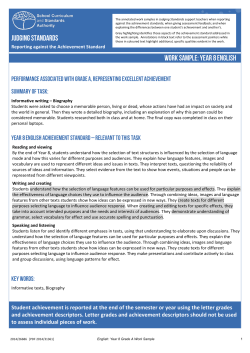


© Copyright 2026